AI, IoT, and Smart Automation Explained: How They Work Together in Enterprises
.jpg)
25 Feb 2026
Businesses are now facing the pressure to work more quickly, smarter, and more efficiently than it has ever before. Digital tools that were isolated and traditionally automated are no longer sufficient. The combination of artificial intelligence (AI), the Internet of Things (IoT), and intelligent automation will bring a real competitive advantage.
This merging is commonly known as AI IoT smart automation and is transforming the way businesses gather data, determine choices, and implement actions on a large scale. The proper integration of AI and IoT in businesses facilitates real-time intelligence, predictive processes, and autonomous processes that facilitate quantifiable business transformations.
This guide describes the collaboration between AI and IoT, real-world enterprise applications, and presents a practical AI IoT integration plan to facilitate digital transformation in the long term.
Understanding the Core Technologies
To see the way this ecosystem functions, one should explain how every technology fits into the setup of enterprise automation solutions.
Artificial Intelligence (AI)
The intelligence layer of a modern enterprise is AI. Using machine learning and predictive analytics, enterprise AI solutions analyze massive volumes of structured and unstructured data to:
- Determine trends and abnormalities.
- Anticipate failures and changes in demand.
- Streamline work and processes.
- Enable data-driven decision-making
The work of AI converts raw data into insight, enabling businesses to leave the reactive response stage and enter the predictive and prescriptive action stages.
Internet of Things (IoT)
The foundation of data is IoT. Enterprises can have 24/7 insights into physical operations through smart sensors and interconnected devices.
Common industrial IoT implementation scenarios include:
- Equipment health monitoring
- Asset and fleet tracking
- Environmental and energy tracking
- Real-time capture production data.
IoT transforms the physical process into a digital stream of data, which allows real-time data analytics on an enterprise level.
Smart Automation
Intelligent execution of smart automation of business seeks to establish a connection between intelligence and execution. Unlike basic automation, it combines AI insights, IoT data, and tools like robotic process automation (RPA) to automate complex, adaptive workflows.
Smart automation systems:
- Respond to real-time conditions
- Learn from outcomes
- Work at enterprise levels
- Non-linear cost growth rates.
AI, IoT, and smart automation are all components that make up Industry 4.0.
How AI and IoT Work Together in Enterprises
The true value is achieved when AI and IoT are a closed-loop system. This is what AI IoT enterprise solutions are based on.
1. Real-Time Data Collection
The IoT devices constantly gather information on machines, infrastructure, supply chains, and facilities. This information is operational, time-sensitive, and high volume.
2. Edge Computing and Cloud Infrastructure
To balance speed and scalability, enterprises use a hybrid architecture:
- Edge computing processes data locally for low-latency responses
- Cloud infrastructure enables large-scale storage, analytics, and model training
This approach ensures performance while supporting enterprise-wide visibility.
3. AI-Driven Intelligence
The use of AI models involves the application of machine learning and predictive analytics to extract trends and predict risks, as well as optimize performance. Models are also enhanced with time as more data is gathered.
4. Intelligent Automation Execution
Once insights are generated, enterprise automation solutions trigger actions automatically:
- Adjusting machine parameters
- Scheduling maintenance
- Rerouting logistics
- Launching RPA workflows across ERP, CRM, and supply chain systems
This cycle defines how AI IoT automation works in enterprises.
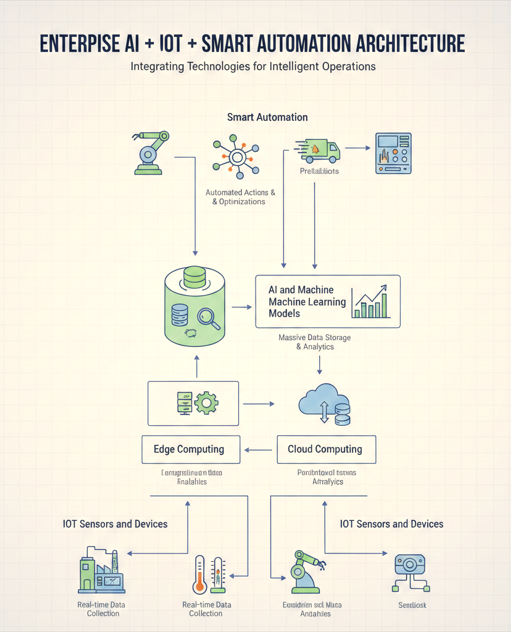
AI, IoT, and Smart Automation Architecture Explained
In order to truly harness the power of AI, IoT, and smart automation, enterprises need a robust architecture that integrates these technologies effectively. Below is a visual breakdown of how these systems interconnect within a smart enterprise environment.
Key Building Blocks of AI IoT Smart Automation Architecture
- IoT Sensors and Devices: Collect real-time data across the enterprise. This data can be from machines, production lines, or environmental factors.
- Edge and Cloud Computing: Edge devices process data locally for quick, low-latency responses while cloud platforms enable large-scale storage, analytics, and advanced AI model training.
- Data Lakes and Warehouses: Collect, store, and analyze massive datasets from IoT devices. These systems provide the backbone for AI model predictions.
- AI and Machine Learning Models: Use the data to predict trends, optimize processes, and automate actions.
- Smart Automation: Deploy actions based on insights gained from AI models, such as re-routing logistics or adjusting machine settings.
Key Benefits of AI and IoT Integration
The integration of AI and IoT in businesses has both operational and strategic benefits.
- Operational Efficiency: Predictive maintenance, automated workflows, and optimized resource utilization significantly reduce downtime and waste.
- Predictive Decision-Making: AI-empowered insights also allow businesses to predict problems before they get out of control and transform reactive firefighting into proactive control.
- Scalability and Agility: AI Internet of Things enterprise systems based on the cloud are not proportionally expensive or complicated to increase in size, location, resources, or systems.
- Foundation for Digital Transformation: Any enterprise digital transformation roadmap is centered around AI and IoT integration, as it will allow them to have smarter factories, connected supply chains, and autonomous operations.
AI IoT Use Cases for Manufacturing and Beyond
Smart Factory AI IoT Implementation
Manufacturing remains the most mature use case for AI IoT integration. Enterprises use connected machines and smart sensors to monitor vibration, temperature, pressure, and performance. AI analyzes this data to:
- Predict equipment failures
- Optimize production schedules
- Automate quality inspections
- Reduce energy consumption
The result is higher uptime, improved quality, and lower operational costs.
Supply Chain and Logistics
IoT trackers provide real-time visibility into shipments and inventory conditions. AI predicts delays, spoilage risks, or demand spikes, while automation reroutes deliveries or adjusts stock levels. This degree of business automation using AI and IoT is essential in global businesses with complex logistics systems.
Energy and Facilities Management
Smart buildings and utilities use IoT sensors to monitor occupancy, HVAC, lighting, and infrastructure health. AI optimizes energy usage patterns, while automation enforces efficiency rules, delivering significant cost savings.
Quality Control and Compliance
Computer vision systems powered by AI inspect products in real time using IoT-connected cameras. Defects are detected instantly, rejected automatically, and logged for compliance and audit workflows.
The Role of RPA in Smart Automation
Robotic process automation (RPA) acts as the execution layer within smart automation. While IoT senses and AI decides, RPA connects intelligence to enterprise systems by:
- Creating maintenance tickets
- Updating ERP and asset management platforms
- Automating compliance reporting
- Triggering procurement and approval workflows
Together, AI, IoT, and RPA enable end-to-end enterprise automation solutions.
Building an AI IoT Integration Strategy
An effective AI IoT integration plan should not be reduced to technology adoption. It requires an orderly and result-oriented process.
- Define Business Objectives: Identify high-impact use cases such as uptime improvement, cost reduction, safety enhancement, or scalability.
- Prepare the Data Foundation: Enterprise AI solutions depend on clean, standardized, and accessible data across systems.
- Design the Right Architecture: Balance edge computing and cloud infrastructure to meet performance, security, and scalability requirements.
- Start with Pilot Projects: A focused deployment (such as predictive maintenance in one production line) should be started first before going enterprise-wide.
- Leverage Expert Services: Most companies use AI consultations, IoT consultations, and digital transformation consultations to accelerate the implementation process and prevent pitfalls such as data silos or the intricate nature of the integration process.
- Scale and Optimize: Refine models and extend automation, and keep improving results throughout the enterprise with real-time analytics.
Challenges Enterprises Must Address
Although it has advantages, AI IoT integration has the following challenges:
- Data silos across legacy systems
- Integration complexity
- Risks of connected devices on cybersecurity.
- Skills and change management deficiencies.
These require early attention in order to achieve sustainability.
The Future of Enterprise Smart Automation
With the maturity of AI models and the growth of IoT ecosystems, businesses are becoming self-optimizing, or systems that learn, improve, and adapt with little human assistance. This convergence is no longer optional. It is the mode of operation of the current businesses. The next stage of operational excellence will be determined by organizations able to succeed in AI IoT smart automation described today.
Build Intelligent Enterprise Solutions with NanoByte Technologies
NanoByte Technologies assists companies in designing, developing, and scaling AI IoT enterprise solutions to generate actual business value. NanoByte ranks between data and action, intelligence, and action with regard to AI IoT integration services and industrial IoT implementation, as well as enterprise-grade smart automation.
When your organization is willing to get out of disconnected systems and manual processes, NanoByte Technologies can help you work through your enterprise digital transformation roadmap, starting with strategy and going all the way to full-scale implementation.
Build smarter. Operate faster. Lead with intelligence.
 (1) (1) (1).jpg)
.jpg)