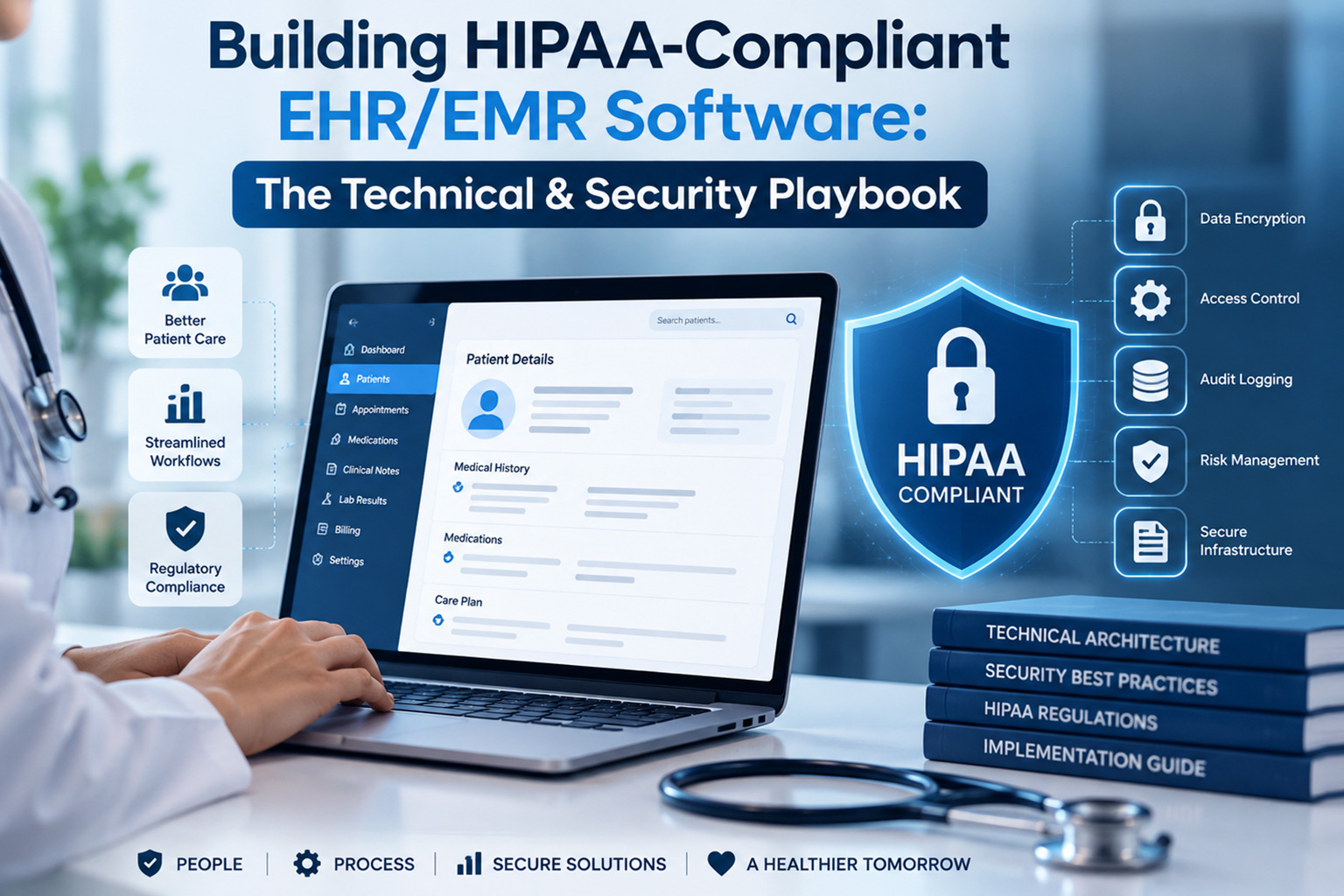
Building HIPAA-Compliant EHR/EMR Software: The Technical & Security Playbook
04 Sep 2026
As all healthcare startups and product leaders realize, compliance with HIPAA is not a checkbox; it's a decision made with regard to architecture. You could lose their trust, lose payer contracts, and face a fine that can exceed $2 million and more. In this playbook, the authors provide detailed insights into the infrastructure, application, and process requirements of a production-class, HIPAA-compliant EHR/EMR system, so that you can brief your engineering team, or your outsourced development team, with confidence.
Quick Summary: How Do You Build a HIPAA-Compliant EHR/EMR Platform?
At every layer of the cloud infrastructure, including for at-rest data, in-transit data, role-based access control, immutable audit logging, and HL7/FHIR v4 interoperability standards, a signed Business Associate Agreement (BAA) is in place.
1. The Healthcare Compliance Risk: Beyond Basic Cloud Storage
The stakes are higher than most first-time healthcare founders expect. Following the January 2026 inflation adjustment, HHS's Office for Civil Rights can now impose civil penalties of up to roughly $2.19 million per violation category, per calendar year, for willful neglect that isn't corrected in time, and that figure climbs further once state attorneys general and potential class-action exposure are added on top. For a growing HealthTech company, a single unresolved risk assessment gap or an unencrypted database backup can be an existential event, not a line item.
The common misconception that lands most teams is that having your application on AWS, Azure, or Google Cloud is not enough to make your software HIPAA-compliant. These providers will provide HIPAA-compliant services and enter into a Business Associate Agreement, though the responsibility is with both parties. Your engineering team is responsible for implementing the technical controls, administrative safeguards, and configuration decisions that ensure the protection of electronic protected health information (ePHI) within the infrastructure, and the cloud vendor secures the infrastructure.
2. Basic Healthcare Web App vs. Production-Grade HIPAA EHR Architecture
The differences between a web app that just happens to deal with patient information and a secure, auditable EHR are reflected in each layer of the stack. The information in the table below provides a snapshot of the current build (or your vendor's proposal) in comparison.
|
Capability |
Basic Healthcare Web App |
Production-Grade HIPAA EHR |
|
Data at rest |
Provider-default encryption (often optional) |
Mandatory AES-256 encryption with managed key vaults |
|
Data in transit |
Standard TLS, versions vary |
Enforced TLS 1.3 across every endpoint and integration |
|
Access control |
Single admin login, shared credentials |
Granular role-based access control (RBAC) with least privilege |
|
Audit trail |
Basic server logs, mutable |
Immutable, timestamped audit logging for every ePHI event |
|
Interoperability |
Custom, one-off data exports |
HL7/FHIR v4 APIs for labs, pharmacies, and hospital systems |
|
Vendor accountability |
Standard cloud Terms of Service |
Signed Business Associate Agreements (BAAs) with every subprocessor |
|
Security validation |
Occasional manual review |
Scheduled SAST/DAST scans and continuous penetration testing |
3. The 4 Technical Pillars of a Custom EHR/EMR Infrastructure
After the foundation, the building blocks of a long-term EHR/EMR system are four. After the foundation, there are four pillars of a long-lasting EHR/EMR system. Compliance gaps and security incidents typically start with the omission of one or more of them.
Pillar 1: Safeguarding ePHI Data Pipelines
Rather than storing identifiable patient data and clinical records together, mature EHR architectures decouple personally identifiable information (PII) from clinical content using anonymized ID mapping, with the mapping keys held in encrypted vaults such as AWS KMS or HashiCorp Vault. If a lower-security service is ever compromised, the breach exposes de-identified clinical data rather than a patient's full identity.
Pillar 2: Interoperability via FHIR v4 & HL7 Standards
A modern EHR can't be a data silo. Building API layers on FHIR v4 and HL7 standards lets your platform exchange patient records securely with external labs, pharmacies, payers, and legacy hospital systems, which is increasingly a prerequisite for payer integrations and hospital procurement, not just a technical nicety.
Pillar 3: Core Functional Modules (eRx, Scheduling & RCM)
Everything from the features clinicians and administrators use on a day-to-day basis, such as e-prescribing (eRx), intelligent clinical scheduling, and automated Revenue Cycle Management (RCM) billing hooks, must be designed with the same level of compliance as the underlying data layer.
Pillar 4: Penetration Testing & Continuous Monitoring
Compliance isn't a one-time certification. Enforcing static and dynamic application security testing (SAST/DAST), running scheduled vulnerability assessments, and maintaining 24/7 telemetry for suspicious access patterns is what keeps a platform audit-ready year-round, not just on launch day.
4. Frequently Asked Questions
How long does it take to build a custom HIPAA-compliant EHR?
A production-ready MVP typically takes 4 to 8 months, depending on feature complexity, the number of FHIR integrations required, and how much regulatory audit preparation is built into the timeline.
What is the difference between an EHR and an EMR?
An EMR holds clinical data from a single practice, while an EHR is built for interoperability, designed to be shared securely across multiple healthcare providers and systems.
How much does it cost to build a HIPAA-compliant EHR/EMR platform?
Costs vary widely with scope, but most custom builds with core modules (scheduling, eRx, billing) and FHIR interoperability range from the low six figures for an MVP to well beyond that for a full multi-provider platform, driven mainly by integration count and compliance audit requirements.
Is a signed BAA enough to make my software HIPAA-compliant?
No. A Business Associate Agreement establishes legal accountability with your vendors, but compliance also requires the technical safeguards (encryption, access control, audit logging) and administrative safeguards (risk assessments, policies, training) working together.
Can I add HIPAA compliance to an existing app later, or does it need to be built in from the start?
It's possible to retrofit compliance, but it's significantly more expensive and time-consuming than designing for it from day one, especially the data pipeline decoupling in Pillar 1, which is difficult to bolt on after clinical and identity data are already intertwined.
5. Build an Audit-Ready EHR Platform with Senior Healthcare Developers
Avoiding costly compliance mistakes and integration delays comes down to who's building the platform. Plugging in pre-vetted, senior healthcare software engineers and FHIR architects- engineers who have already shipped HIPAA-compliant, high-throughput EHR/EMR platforms- is consistently faster and less risky than assembling a team from scratch or hiring generalist developers unfamiliar with ePHI-specific architecture.
Whether you need a full custom EHR software development services engagement or want to hire remote healthcare developers to extend an in-house team, the goal is the same: an architecture that passes audits the first time and scales as your provider network grows.
|
Planning to Build a Custom EHR/EMR System or HealthTech Portal? Launch a secure, high-throughput, audit-ready HIPAA platform. Connect with NanoByte Technologies' HealthTech architects for a free 15-minute EHR architecture and compliance audit. |
Other Posts
.jpeg)