Enterprise LLM Integration: Build, Buy, or Use an AI Gateway?
25 Aug 2026
1. The Integration Dilemma: Custom Engineering vs. SaaS Lock-In vs. Gateway Middleware
Every enterprise adopting generative AI eventually hits the same wall. A pilot project connects one team's application directly to a provider API, OpenAI, Anthropic, or Google, and it works. Then a second team does the same thing with a different model. Then a third. Within a year, an organization can have a dozen microservices each holding their own API keys, their own rate limits, and their own idea of what "acceptable cost" looks like.
This is how enterprise LLM integration quietly turns into technical debt. Point-to-point connections between applications and model providers create security blind spots (who is sending customer data where?), unpredictable spend (which team's usage spiked the invoice?), and a migration headache the moment a better or cheaper model becomes available.
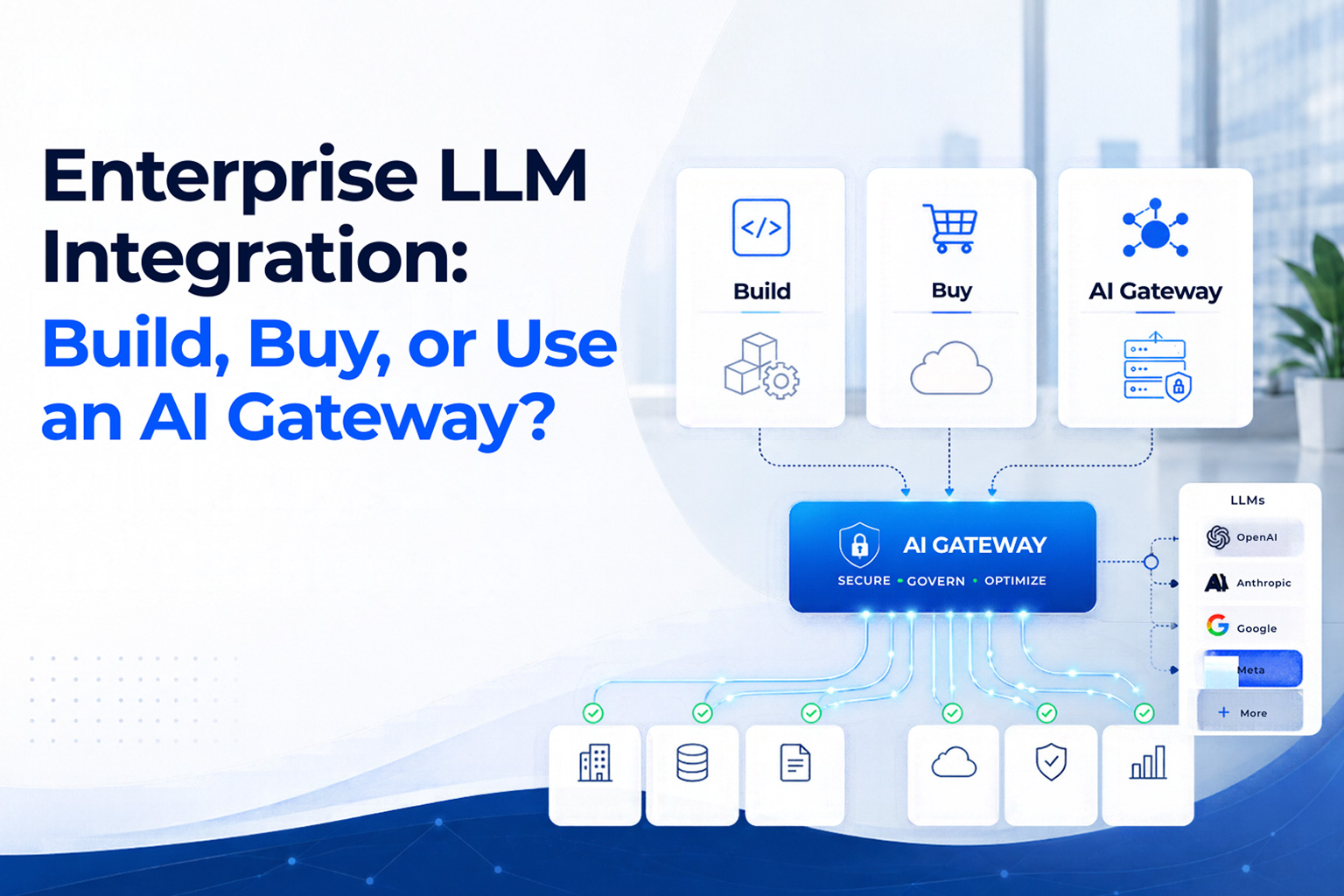
The question enterprise leaders are actually asking is broader than "which model should we use." It is a build vs. buy vs. gateway decision: do you engineer a custom integration layer in-house, buy a closed commercial SaaS AI suite, or deploy a unified enterprise AI gateway that sits between your applications and every model provider you use?
2. Build vs. Buy vs. AI Gateway: Strategic Comparison Matrix
Each path trades off control, speed, and long-term flexibility differently. The matrix below breaks down how custom builds, commercial SaaS suites, and gateway middleware compare across the five factors that matter most for enterprise AI cost and governance.
|
Decision Vector |
Custom In-House Build |
Commercial SaaS Suite (Buy) |
Enterprise AI Gateway (Recommended) |
|
Vendor Lock-In |
Low, full control over the stack |
High, tied to one vendor's roadmap and pricing |
Low, swap or add models behind one API |
|
Time-to-Market |
Slow, typically several months of engineering |
Fast, near-immediate onboarding |
Fast- middleware deploys in days, not quarters |
|
Cost & Latency Control |
Manual, requires ongoing tuning |
Fixed subscription, limited flexibility |
Built-in caching, rate-limiting, and model routing |
|
Data Governance |
Custom security build required from scratch |
Dependent on the vendor's compliance posture |
Centralized PII masking, RBAC, and audit trails |
|
Engineering Overhead |
High ongoing maintenance burden |
Lower upfront, but long-term costs compound |
Low, offloaded to a managed engineering pod |
The pattern that stands out: a custom build maximizes control but is slow to ship and expensive to maintain. A commercial SaaS suite is fast to adopt but trades away flexibility and can quietly lock an organization into one vendor's pricing and roadmap. An enterprise AI gateway is designed specifically to avoid that trade-off; it gives teams a single, model-agnostic integration point while keeping governance and cost control centralized.
3. The 4 Core Capabilities of an Enterprise AI Gateway
Not all middleware is built the same. A gateway that genuinely reduces engineering overhead and governance risk needs to cover four capabilities.
Pillar 1: Dynamic Model Routing & Fallbacks
A well-architected gateway automatically routes simple, low-stakes prompts to lower-cost open models and reserves frontier models for complex reasoning tasks. When a provider has an outage or hits a rate limit, the gateway fails over to an alternate model automatically, so application uptime doesn't depend on a single vendor's availability.
Pillar 2: Semantic Caching & Rate-Limiting
Enterprise applications generate a surprising amount of duplicate or near-duplicate queries across teams. A gateway that intercepts these at the middleware layer, rather than sending every request to the model provider, can meaningfully cut down on redundant API spend and enforce per-team or per-application usage quotas before costs get out of hand.
Pillar 3: Centralized Security & PII Redaction
Rather than trusting every individual microservice to handle sensitive data correctly, a gateway gives you one place to strip customer PII, medical information, or proprietary financial data before it ever leaves your cloud perimeter, a meaningfully smaller surface area to audit and secure than a dozen independent integrations.
Pillar 4: Unified Telemetry & Cost Analytics
Token consumption, latency, and cost attribution are visible in one dashboard instead of scattered across provider billing portals. That visibility is what makes it possible to answer, with confidence, which team or application is driving spend, and to catch a cost spike before it shows up on the invoice.
4. Deploy an Enterprise-Grade AI Gateway Strategy Without Engineering Friction
Choosing "gateway" as the right architecture is only the first decision. The next is how to build and operate it. Standing up a production-grade gateway, with routing logic, caching, PII redaction, and audit-ready telemetry, is itself a meaningful engineering lift, which is exactly the kind of specialized work that benefits from experienced hands rather than a first attempt in-house.
NanoByte Technologies works with engineering teams to design and deploy secure, high-throughput AI gateways tailored to an organization's existing stack, compliance requirements, and model mix, without the multi-quarter timeline of a fully custom build or the lock-in of a closed SaaS suite. For teams that want the gateway approach but need additional engineering capacity to build or operate it, our AI architecture specialists and remote engineering pods plug in alongside existing teams rather than replacing them.
5. Future-Proof Your Enterprise LLM Architecture Today
Build, buy, and gateway are all viable strategies; the right one depends on your team's engineering capacity, compliance requirements, and how many model providers you expect to work with over the next few years. What matters most is making that decision deliberately, before technical debt makes it for you.
Frequently Asked Questions
|
Trying to Decide Between Custom LLM Integration, SaaS Suites, or an AI Gateway? Build a flexible, secure, and cost-optimized AI pipeline your enterprise can scale. Connect with NanoByte's AI Architecture Specialists for a free 15-minute LLM Integration & Gateway Audit. |
Is an AI gateway the same thing as an API management tool?
Not quite. General API gateways manage traffic and authentication for any API. An AI gateway adds LLM-specific capabilities on top of that — semantic caching, token-aware rate limiting, model routing across providers, and PII redaction tuned for prompt-and-response payloads rather than generic REST traffic.
Do we still need a gateway if we only use one model provider today?
Most enterprises that start with a single provider add a second within a year, whether for cost reasons, model performance, or resilience during an outage. A gateway makes that transition a configuration change instead of a re-engineering project, which is usually the more expensive lesson to learn later rather than sooner.
How long does it take to deploy an enterprise AI gateway?
Timelines vary with your existing stack and compliance requirements, but gateway middleware is typically deployable in days to a few weeks — a fraction of the multi-month timeline of a fully custom integration build.
Does a gateway approach work for regulated industries like finance or healthcare?
Yes — centralized PII redaction, role-based access control, and audit trails are particularly valuable in regulated environments, since they give compliance teams one integration point to review instead of auditing every application that calls a model provider directly.