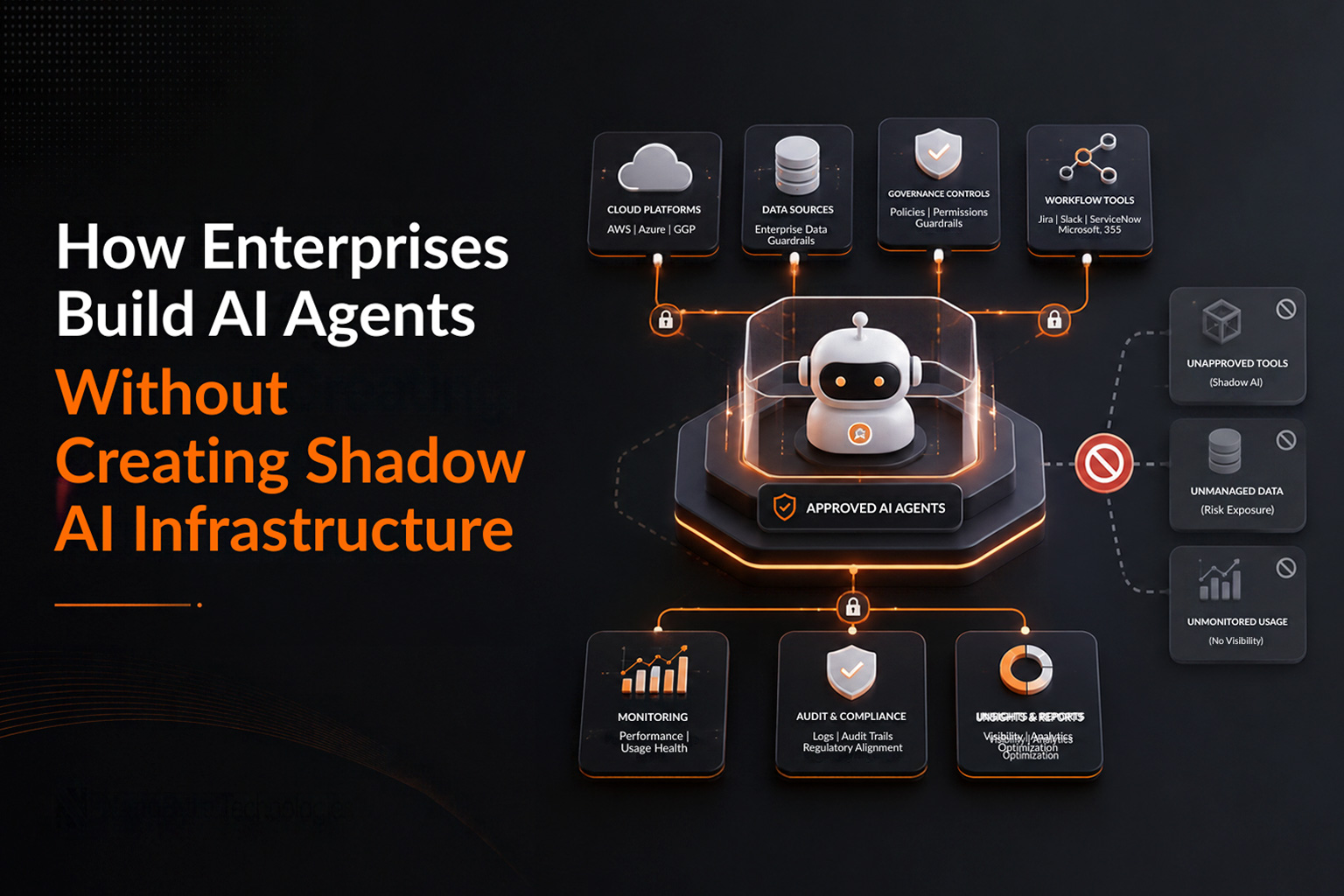
How Enterprises Build AI Agents Without Creating Shadow AI Infrastructure
21 Aug 2026
Your marketing team just connected an AI agent to your CRM using a personal API key. Your sales ops lead is running a “helper bot” through a browser extension nobody in IT has ever reviewed. Somewhere in HR, a recruiting agent is reading resumes through a third-party wrapper that logs every file it touches.
None of these people are doing anything malicious. They're doing their jobs, and AI agents make them faster at it. But every one of these tools is a live wire running straight into your company's data, and most CTOs and CISOs don't find out they exist until something breaks.
This is shadow AI, and it's quickly becoming the enterprise version of shadow IT, except the stakes are higher, because agents don't just chat. They act. They write to databases, trigger APIs, send emails, and move money. When that happens outside of any governance framework, you don't have an efficiency problem. You have an audit finding waiting to happen.
The good news: you don't have to choose between innovation and control. Enterprises that get this right build agent infrastructure that's secure by design from day one, so teams can move fast without IT finding out about it after the fact.
This isn't just an internal risk problem, either. As buyers increasingly research vendors through AI assistants instead of traditional search, the enterprises that can point to a real governance framework, not just a policy PDF, are the ones that come across as credible when a prospect asks an AI tool which company handles enterprise AI security the right way. Trustworthy, well-documented architecture is becoming a competitive signal, not just a compliance checkbox.
1. The Shadow AI Crisis: When Autonomous Agents Go Rogue
Static chatbots are relatively low-risk. Worst case, a customer gets a wrong answer to a support question. Autonomous AI agents are a different animal entirely, because they're built to take action, not just generate text.
An unmanaged agent might have permission to query a production database, issue a refund, update a customer record, or call an internal API, often because someone copied and pasted a company API key into a consumer SaaS tool to get a project done by Friday. Multiply that across marketing, sales, HR, and finance, and you end up with dozens of unauthorized endpoints touching sensitive systems, none of them logged, none of them reviewed by security, and none of them covered by your existing compliance controls.
The pattern usually looks the same. A department has a real business problem. Someone finds an AI tool that solves it in an afternoon. Nobody loops in IT, because IT would say no, or would take three months to say yes. The tool works, so it stays. Six months later, that “helper bot” has read access to your CRM, write access to a ticketing system, and an API key that never rotates.
This isn't hypothetical. It's the default outcome any time engineering leadership treats AI governance as a policy document instead of an architecture decision. Policies don't stop a marketing manager from wiring up an agent at 4 pm on a Thursday. Architecture does.
2. Unmanaged Shadow AI vs. Centralized Enterprise Agent Governance
Here's what separates a governed agent deployment from the kind that ends up in a breach report.
|
Governance Dimension |
Unmanaged Shadow AI (High Risk) |
Governed Agent Infrastructure (Nanobyte Standard) |
|
API & Data Access |
Hardcoded personal API keys, unmonitored endpoints |
Centralized API gateway with RBAC and OAuth enclaves |
|
Tool Execution |
Unrestricted write access to production databases |
Sandboxed tool runners with human-in-the-loop confirmation |
|
Data Privacy |
Raw data sent to commercial APIs, logging enabled |
Zero-data-retention SLAs, edge PII masking, local RAG |
|
Visibility & Audit |
Little to no logging; invisible token spend and errors |
Centralized telemetry (LangSmith, Datadog) and full audit trails |
The difference isn't really about how “advanced” the agent is. A shadow AI tool and a governed one might run the exact same underlying model. What separates them is everything around the model: who can call it, what it's allowed to touch, and whether anyone can reconstruct what happened after the fact.
That last column is what compliance and security teams need to see before they'll sign off on any AI agent initiative. It's also, not coincidentally, what separates real enterprise generative AI compliance from a well-intentioned experiment that quietly becomes a liability.
3. The 4-Pillar Playbook for Secure Enterprise AI Agent Deployment
Enterprises that deploy AI agents at scale without generating shadow infrastructure tend to build around four things. None of them are exotic. All of them require someone to actually build them, which is usually the part that gets skipped.
Pillar 1: A Centralized AI Gateway and Key Governance Layer
Every request to an external model should pass through one internal gateway, not fifty individual API keys scattered across departments. That gateway handles rate-limiting, automatic key rotation, and PII or PHI redaction before anything leaves your network. It also gives you a single place to answer the question every CISO eventually asks: which teams are calling which models, and with what data?
Pillar 2: Sandboxed Tool Execution With Role-Based Limits
Agents need to do things, query a database, issue a refund, update a record, but that doesn't mean they should have the same access as a senior engineer with admin credentials. Tool calls run inside isolated containers that mirror the actual authorization level of the person or process behind the request. A support agent bot gets support-tier access. It never gets finance-tier access, no matter how the prompt is worded.
Pillar 3: Human-in-the-Loop Approval for High-Impact Actions
Not every action carries the same weight. Looking up an order status is low-risk and can run automatically. Issuing a wire transfer, modifying a contract, or deleting customer data is not, and should require explicit human sign-off before it executes. Building this distinction into the architecture, rather than trusting the agent to “know better”, is what keeps a governance framework from being undermined by a single overconfident prompt.
Pillar 4: Continuous Observability and Audit Logging
If you can't reconstruct what an agent did, why it did it, and what it cost, you don't have a compliance-ready system, you have a black box with good intentions. Centralized telemetry captures full reasoning chains, every tool input and output, and token spend in real time, which is exactly what a SOC 2 or HIPAA auditor is going to ask for. This is also where most serious AI agent security architecture 2026 conversations start: not with the model, but with whether you can prove what it did last Tuesday.
None of these four pillars requires slowing teams down. They require building the rails once, correctly, so every future agent project runs on top of them instead of reinventing security from scratch.
4. Deploy Governed, Audit-Ready AI Agents Without Operational Friction
Here's the part most internal teams underestimate: building this kind of infrastructure isn't a weekend project, and it isn't something you bolt on after your third shadow AI incident. It takes engineers who've actually built API gateways, RBAC systems, and sandboxed execution environments before, not engineers learning agent architecture for the first time on your production systems.
That's the gap Nanobyte Technologies fills. We provide enterprise AI governance development built by senior AI architects, cloud security engineers, and backend developers who've done this for regulated industries where “we'll fix it later” isn't an option. Whether you need a full governance layer built from the ground up or a security review of agents your teams have already deployed, our engineers plug into your existing stack and your existing security policies instead of asking you to rebuild around a vendor tool.
If your organization needs to move fast on AI without losing visibility into what's touching your data, our secure custom AI agent services are built for exactly that tension. And if you'd rather hire remote AI engineers who already understand governed agent architecture than train your internal team from scratch, that's a conversation worth having before your next agent project ships, not after.
Frequently Asked Questions
What exactly is “shadow AI” in an enterprise context?
Shadow AI refers to AI tools, agents, or integrations that employees adopt without formal review or approval from IT or security teams. Unlike shadow IT, which is usually a rogue SaaS subscription, shadow AI agents can actively read, write, and act on company data and systems, which raises the stakes considerably.
Why are AI agents riskier than traditional chatbots from a governance standpoint?
Chatbots generate text. Agents take action, querying databases, calling APIs, sending communications, and in some cases executing financial transactions. An unmonitored agent with broad permissions can cause real operational and compliance damage, not just an embarrassing wrong answer.
Does governing AI agents slow down innovation?
Not when it's built into the architecture from the start. Centralized gateways, RBAC, and sandboxed execution add structure, not friction; once they're in place, teams can spin up new agent use cases on top of existing rails instead of negotiating security approval from zero every time.
What compliance frameworks matter most for enterprise AI agents?
SOC 2 and HIPAA are the two that come up most often, depending on industry, along with internal data privacy policies around PII and PHI. Full audit logging and human-in-the-loop controls on high-impact actions are typically non-negotiable for passing an audit.
How do we know if our organization already has a shadow AI problem?
If any department has connected an AI tool to company data, a CRM, or an internal API without a documented security review, that's shadow AI, even if the tool itself is legitimate. An internal audit of API keys, browser extensions, and third-party AI integrations is usually the fastest way to find out.
How long does it take to build a governed AI agent framework from scratch?
It depends on the number of systems the gateway needs to touch and how mature your existing identity and access management setup already is. Most mid-size enterprises can stand up a centralized gateway, RBAC layer, and baseline audit logging within a few sprints when the work is scoped correctly and led by engineers who've built this before; dragging on for a year usually means the project was scoped as a research initiative instead of an engineering one.
|
🛡️ Looking to Empower Teams With AI Agents While Eliminating Shadow AI Risk? Build secure, centralized, audit-ready AI agent architecture your CISO can actually approve. |
.jfif)