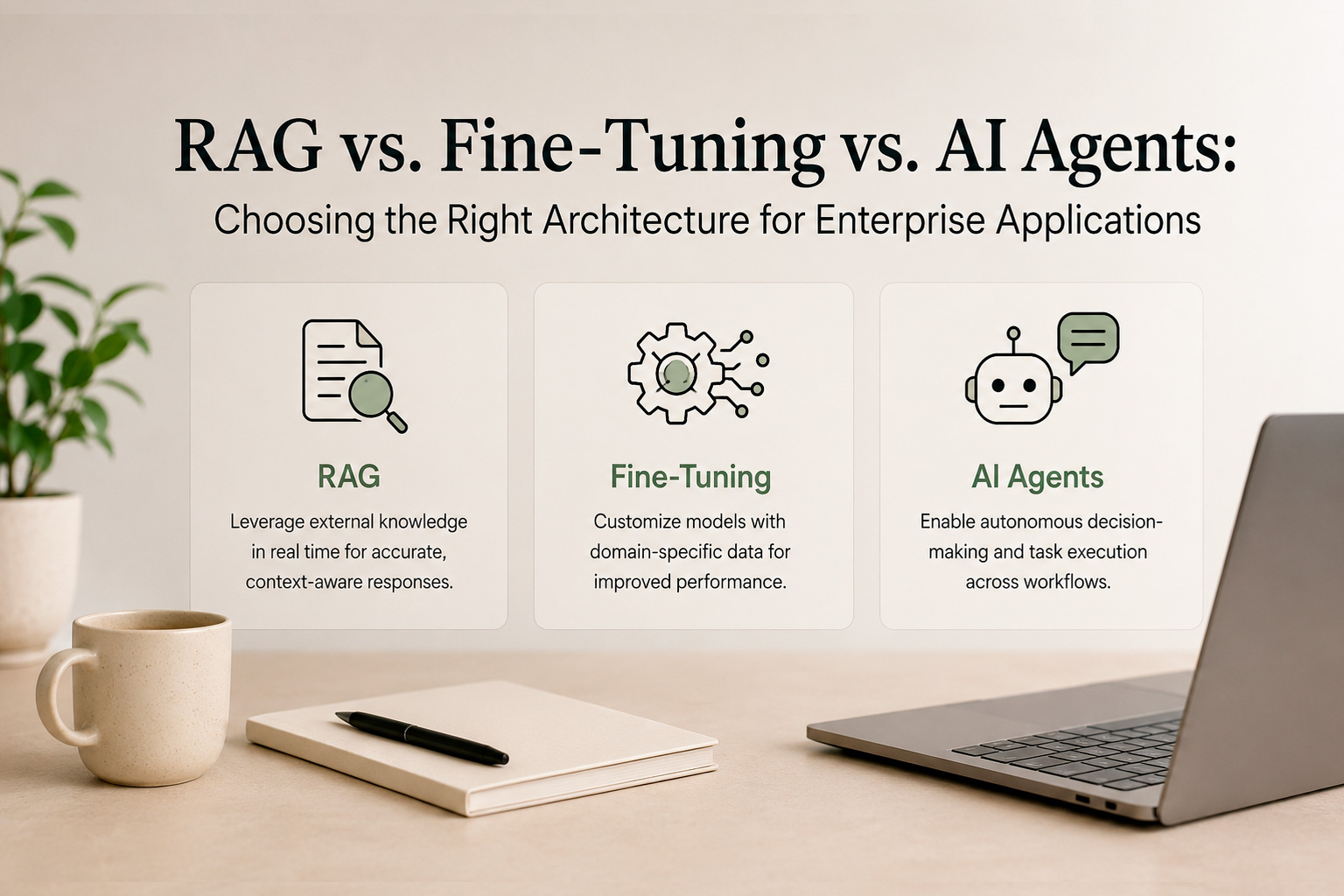
RAG vs. Fine-Tuning vs. AI Agents: Choosing the Right Architecture for Enterprise Applications
19 Aug 2026
Somewhere between the whiteboard and the invoice, most enterprise AI projects go sideways. A team decides fine-tuning is the “serious” way to build an AI feature, spends six figures curating datasets and running GPU jobs, and ships a model that still confidently states last quarter’s pricing as current. Another team wires up a RAG pipeline over their documentation, gets clean answers to simple questions, then hits a wall the moment a user asks the system to actually do something, check a calendar, pull a CRM record, trigger a refund.
If you’re a CTO, VP of Engineering, or SaaS founder trying to work out whether your product needs retrieval-augmented generation (RAG), a fine-tuned model, an autonomous AI agent, or some combination of the three, you’re not alone, and the cost of guessing wrong is rarely just wasted compute.
1. The Enterprise AI Dilemma: Over-Engineering vs. the Wrong Architectural Fit
Engineering teams often default to fine-tuning because it sounds like the “real” engineering solution; training a model feels more defensible in a roadmap review than “we added a vector database.” In practice, fine-tuning is frequently the wrong first move. It bakes knowledge into model weights at a fixed point in time, so the moment your internal policies, pricing, or product catalog change, the model is out of date again, and updating it means another costly training cycle.
Meanwhile, teams that lean entirely on a basic RAG setup run into a different ceiling. Retrieval is excellent at answering “what does our refund policy say,” but it has no native way to handle multi-step business logic like “check this customer’s plan, compare it to their usage, and draft a personalized upgrade proposal.”
The business impact of picking the wrong paradigm rarely shows up on day one. It shows up months later as an API or GPU bill that doesn’t match the value delivered, a product roadmap that stalls because the underlying architecture can’t support the next feature, internal debate over whether customer data used in training carries a leakage risk, and a user experience that feels brittle the moment a query falls outside the happy path.
2. The Strategic Enterprise Matrix: RAG vs. Fine-Tuning vs. AI Agents
Here is how the three approaches compare across the dimensions that matter for a production system, not a demo.
|
Architectural Vector |
RAG |
Fine-Tuning (SLMs/LLMs) |
Autonomous AI Agents |
|
Core Strength |
Dynamic knowledge retrieval with low hallucination on proprietary data |
Custom tone, domain syntax, and specific task formatting |
Complex multi-step reasoning, tool execution, and planning |
|
Knowledge Updating |
Near-instant (re-index the vector database) |
Static (requires a new training or fine-tuning cycle) |
Dynamic (queries live APIs and RAG vector stores) |
|
Data Privacy & Governance |
Easier role-based access control at the vector level |
Model weights can memorize sensitive training data |
Requires strict tool-use guardrails and action limits |
|
Development Complexity |
Moderate (vector DB setup, chunking, reranking) |
High (dataset curation, GPU clusters, evaluation) |
High (state management, orchestration, fallback logic) |
|
Primary Use Case |
Internal knowledge bases, policy Q&A, document search |
Domain-specific notation (legal, medical, code generation) |
Automated support, workflow execution, lead triage |
3. When to Choose Which Architecture (Or Combine Them)
Scenario A: Choose RAG When Knowledge Changes Rapidly
RAG is the right call when your product needs to answer questions grounded in information that moves- live databases, Notion docs, Jira tickets, or internal policy manuals. Because RAG retrieves facts at query time instead of memorizing them, updating the system is as simple as re-indexing a vector database, which can happen close to real time. For SaaS platforms where the answer depends on what’s true today rather than what was true at training time, RAG is usually the most cost-effective starting point.
Scenario B: Choose Fine-Tuning for Domain Precision & Cost Efficiency
Fine-tuning earns its complexity when you need a smaller, open-source model, a Llama 3 8B-class model, for example, to reliably produce a very specific output, such as structured JSON, medical terminology, or proprietary code syntax, at meaningfully lower latency and cost than calling a large commercial API for every request. Think of fine-tuning as teaching a model a skill or a style rather than teaching it facts. The upfront investment in data curation and training is real, but it can pay off once that task is running at volume.
Scenario C: Choose AI Agents for Multi-Step Autonomous Workflows
Agents make sense the moment your system needs to do something rather than just say something. Checking a calendar, querying a CRM, drafting a proposal, and sending it through an API is a chain of actions, not a single generation task, exactly the kind of multi-step reasoning and tool execution that RAG and fine-tuning alone aren’t built for. Agents introduce their own complexity, particularly around state management and guardrails on what actions the system can take without human review, but they’re the only architecture of the three designed for autonomous execution.
The Hybrid Approach: The Enterprise Gold Standard
In practice, the most resilient enterprise AI systems rarely rely on a single paradigm. A common and effective pattern combines a fine-tuned small model for consistent output formatting, a RAG pipeline for dynamic, up-to-date facts, and an AI agent layer that orchestrates both to actually execute tasks. This hybrid architecture lets each component do what it does best instead of stretching one technique to cover all three jobs.
4. Accelerate Your AI Feature Roadmap with Battle-Tested Engineers
Picking the right architecture is only half the problem; building it well, on a reasonable timeline, is the other half. Architectural missteps are expensive twice over: once in the GPU or API spend from building the wrong thing, and again in the engineering hours spent unwinding it.
NanoByte Technologies’ AI Solutions Architects and backend engineers work alongside your team to evaluate your existing data pipelines, recommend the right mix of RAG, fine-tuning, and agent orchestration for your actual use case, and build production-grade systems rather than prototypes that don’t survive contact with real users. Whether you need one senior AI engineer embedded in your team or a full pod to own the buildout end to end, NanoByte Technologies lets you hire remote AI engineers who plug into your existing workflow instead of asking you to adapt to theirs.
5. Build an Audit-Ready AI Infrastructure Today
|
🤖 Unsure Whether Your Enterprise App Needs RAG, Fine-Tuning, or Autonomous AI Agents? Stop wasting runway on trial-and-error AI prototypes. Connect with NanoByte Technologies’ AI Solutions Architects for a Free 15-Minute Technical Feasibility & Architecture Audit. |
Frequently Asked Questions
What is the main difference between RAG and fine-tuning?
RAG retrieves relevant information from an external knowledge source at the moment a query is made, so answers stay current without retraining. Fine-tuning instead adjusts the model’s internal weights during a training process, which suits teaching a model a consistent style, format, or specialized vocabulary better than keeping it current on fast-changing facts.
Can RAG and fine-tuning be used together?
Yes, and for many enterprise use cases this hybrid setup outperforms either approach alone. A fine-tuned model can handle formatting and domain-specific language while a RAG pipeline supplies current, accurate information at query time.
Are AI agents a replacement for RAG or fine-tuning?
No. AI agents are an orchestration layer built for planning and executing multi-step actions, and they frequently call RAG pipelines or fine-tuned models as tools within a larger workflow rather than replacing them.
What does enterprise RAG pipeline implementation typically involve?
Scope varies with data volume and complexity, but RAG implementations generally involve vector database setup, document chunking and embedding, and retrieval tuning- work that is typically far less resource-intensive than a full fine-tuning cycle. An architecture audit is the most reliable way to scope your specific case.
Should we hire in-house AI engineers or bring in outside help?
Many SaaS teams bring in specialized remote AI engineers for the initial architecture decisions and buildout, since evaluating RAG, fine-tuning, and agent tradeoffs correctly the first time is where most of the cost risk lives, then decide on in-house hiring once the system’s direction is proven
.png)
.jfif)