
Zero-Downtime Database Migrations: Schema Evolution Strategies Without Locks
13 Oct 2026
A product team needs a new column on a table with hundreds of millions of rows. Traffic cannot stop. The DDL statement looks harmless, yet it could queue behind a long-running transaction, stall every query that arrives after it, lag your replicas, or break older application pods still serving requests mid-deploy.
That scenario is why a zero downtime database migration enterprise teams can trust is rarely about one statement. The real challenge is coordinating schema, application code, data migration, and deployment order so every step stays compatible with the one before it.
One clarification first: zero-downtime migration is a deployment strategy and an operational objective, not a guarantee that every schema change runs without locks or risk. Outcomes depend on the database engine, table size, workload, DDL operation, tooling, replication architecture, and rollback plan.
Quick Summary: How Do You Execute Zero-Downtime Database Migrations?
|
Teams commonly use the Expand-Contract pattern: add backward-compatible schema structures, deploy application code that works with both versions, backfill data in controlled batches, verify consistency, switch reads gradually, and remove legacy structures later. This minimizes blocking and deployment risk, but it does not guarantee zero locks, zero downtime, or automatic rollback. |
1. The Maintenance Window Fallacy: Why Table Locks Cause Outages
A maintenance window schedules risk; it does not remove it. For systems that need high availability, sound migration design matters more than the calendar, and windows shrink as data grows.
Execution time is only part of the danger. Most DDL must first acquire a lock, and lock requests queue. If a long-running transaction holds a conflicting lock, the DDL waits, and later requests can line up behind it. Latency climbs, connection pools fill, and a millisecond change becomes an incident. Replicas add another dimension, because a heavy DDL or backfill can raise replication lag and delay reads served from followers. Table size, indexes, transaction duration, workload, replication, and engine version all shape the result.
PostgreSQL. The ALTER TABLE documentation states that an ACCESS EXCLUSIVE lock is acquired unless explicitly noted, and that lock conflicts with all other access to the table. Subforms still differ. Adding a column with a non-volatile default is a fast metadata change, while a volatile default, a stored generated column, or most column type changes can rewrite the table and its indexes. Adding a CHECK or NOT NULL constraint scans the table without rewriting it. Lock level and lock duration are separate questions.
MySQL. Behavior depends on the operation, engine, version, and algorithm (INSTANT, INPLACE, or COPY). Even online operations pass through metadata locks: the MySQL 8.4 documentation notes that an online DDL statement may wait for transactions holding metadata locks, and that its pending exclusive metadata lock blocks subsequent transactions on the table.
2. Big-Bang Schema Updates vs. the Expand-Contract Pattern
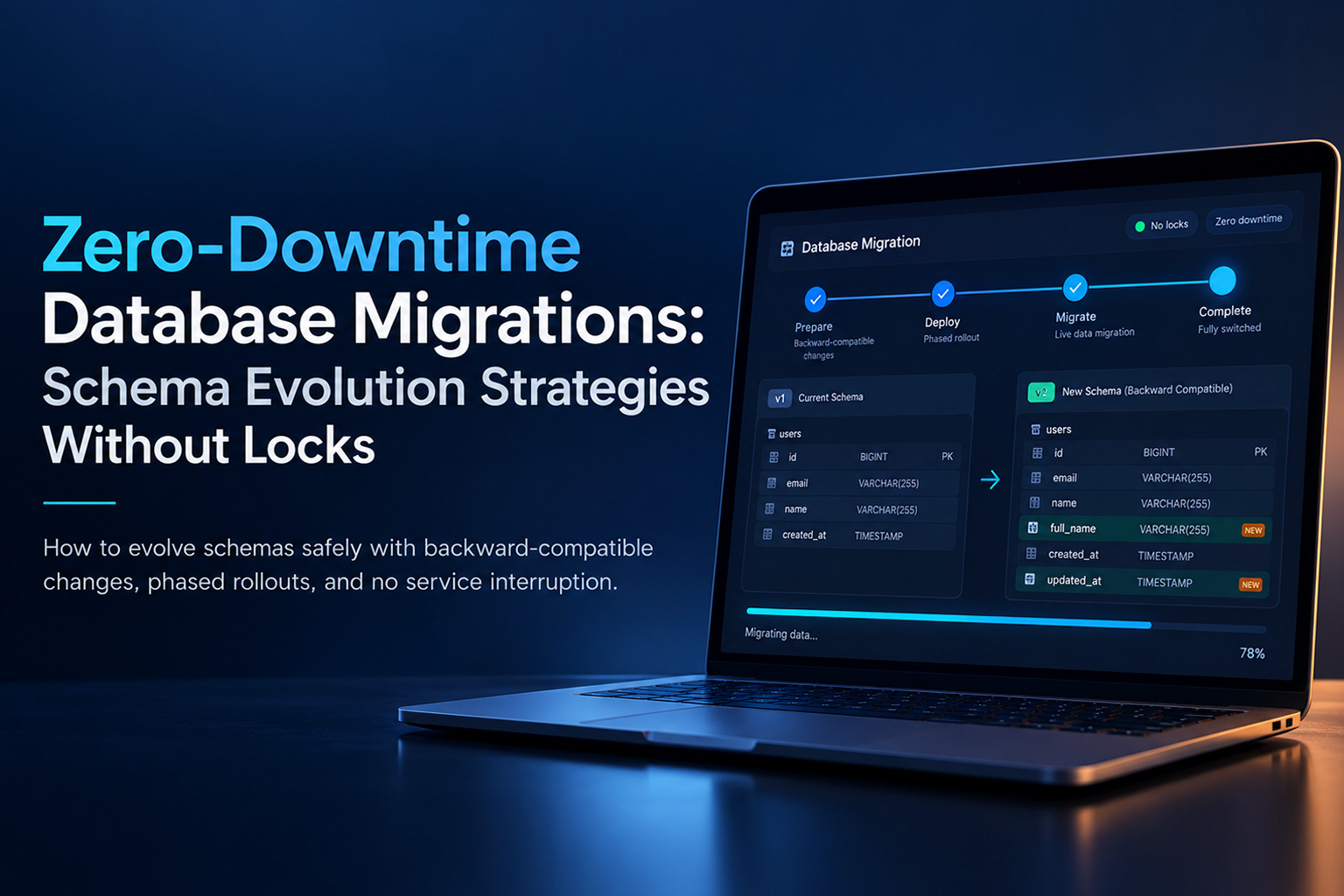
A big-bang migration couples the schema change to the application release. Expand-Contract, also known as parallel change, splits the work into expand, migrate, and contract phases that can each ship independently.
|
Dimension |
Big-Bang Migration |
Expand-Contract |
|
Deployment sequence |
Application and schema changes are tightly coupled |
Changes are split into compatible phases |
|
Compatibility |
Old code may fail against the new schema |
Old and new code can coexist when designed correctly |
|
Data migration |
May combine structural change and data transformation |
Backfill and verification can run as separate steps |
|
Rollback |
May require complex restoration or forward fixes |
Application rollback may remain possible before contract, subject to data compatibility |
|
Operational risk |
Larger coordinated change |
Risk is distributed across controlled stages, but not eliminated |
The key limitation: once new writes or transformations make data unreadable to the old application, rolling back application code alone may no longer be safe. Rollback is only as reliable as compatibility at the current stage.
3. The Four Technical Pillars of Safer Schema Evolution
Each pillar answers a different failure mode: incompatibility, inconsistency, load, and irreversible cleanup. Skipping one usually moves the risk rather than removing it.
Pillar 1 — Expand: Introduce Backward-Compatible Schema Changes
Add new columns, tables, indexes, or compatible structures before touching old ones. A nullable column, or a column with a safe default where your engine supports it, is the usual start. The first deployment must leave the current application version fully functional, which means it should neither read nor depend on the new structure yet.
Additive DDL is not inherently non-blocking. It still takes locks and consumes resources, so test it on your exact engine version with representative data volumes. In PostgreSQL, CREATE INDEX CONCURRENTLY can build indexes without blocking writes, with its own trade-offs, and adding a constraint as NOT VALID followed by VALIDATE CONSTRAINT shrinks lock impact because validation takes only a SHARE UPDATE EXCLUSIVE lock.
Pillar 2 — Dual-Writes and Application Abstraction
While reads stay on a known-good source, application code can temporarily write to both representations. Two separate writes are not atomic by default. Use one transaction where possible, and plan for partial failure: what happens when the old write commits, and the new one fails? Retries, idempotent writes, and a reconciliation job that detects and repairs drift are the usual answers.
Change-data capture, a transactional outbox, or database triggers can be more reliable than application-level dual writes, each with operational costs. Dual-writing is a transitional technique with an end date, not a default design.
Pillar 3 — Asynchronous Backfills and Online Migration Tools
Populate the new structure from historical rows in manageable batches. Set batch sizes and rate limits deliberately, throttle on replication lag, query latency, and error rates, and make the job restartable with checkpoints, progress tracking, and idempotent updates. A backfill without throttling is just a slower outage. Rows change during a backfill, so the write path from Pillar 2 must already be live. Verify completeness and consistency before switching reads.
Tooling is engine-specific. gh-ost is a triggerless MySQL tool that reads the binary log and applies changes to a ghost table. pt-online-schema-change also targets MySQL but copies rows into a new table and uses triggers. pg_repack is a PostgreSQL extension that reorganizes tables and indexes with minimal locks; it addresses bloat, not every schema change. These tools are not interchangeable; none eliminates locking or replication impact, and each has requirements. Confirm current documentation first.
Pillar 4 — Contract: Switch Reads and Remove Legacy Structures Safely
Verify the new representation with automated checks. Move reads through a controlled rollout or feature flag, watching correctness, latency, errors, and business-critical queries. Keep rollback options until confidence is earned, and compare results from the old and new read paths before retiring either one.
Then remove legacy columns or tables in a later deployment, after confirming no running application version or downstream consumer depends on them. Dropping a column is its own risk-bearing change, and delaying cleanup is usually safer than bundling it with the initial migration.
4. How to Rename a Column in a High-Traffic PostgreSQL Database Without Downtime
A direct ALTER TABLE ... RENAME COLUMN changes metadata only, so it can be quick, and it is not forbidden. But it takes an ACCESS EXCLUSIVE lock and immediately breaks any running application version or downstream consumer still using the old name. When old and new versions must coexist, use a compatibility-first sequence:
- Add the new column using a tested definition.
- Deploy code that handles both representations.
- Introduce a consistency strategy for new writes.
- Backfill historical rows in controlled batches.
- Verify completeness and consistency, including writes made during the backfill.
- Gradually switch reads to the new column.
- Confirm no running application version or downstream consumer uses the old column.
- Remove the legacy column in a later deployment.
The exact sequence depends on the data model, consistency requirements, deployment architecture, and PostgreSQL version. Step 1 might look like this:
|
SET lock_timeout = '3s'; ALTER TABLE customers ADD COLUMN full_name text; |
The lock_timeout makes the statement fail fast instead of queuing behind a long transaction; retry when the table is quieter. This is a starting point, not production-ready dual-write code.
5. Production Readiness: What to Verify Before, During, and After Migration
- Test on representative data and realistic workloads.
- Review expected lock behavior and DDL impact for your exact version.
- Set sensible lock_timeout and statement_timeout values.
- Check long-running transactions and active sessions first.
- Monitor latency, errors, resource usage, replication lag, and migration progress.
- Confirm backups and recovery procedures fit the risk.
- Define stop conditions, escalation paths, and a tested recovery strategy.
- Verify data correctness before and after the read switch.
- Document the migration and assign clear ownership.
A tested recovery plan is not a guarantee of instant rollback. It shows you what recovery costs at each stage.
6. Enterprise Schema Evolution Requires More Than a Migration Script
Senior database and backend engineering support pays off with very large production tables, strict availability requirements, cross-version application deployments, complex data transformations, replication constraints, and limited operational windows.
NanoByte Technologies is a software engineering partner that can help teams scope custom database migration consulting, plan PostgreSQL and MySQL schema changes, and shape enterprise schema evolution around application availability. Engagements start from your engine, workload, and constraints, because no migration is risk-free. Whether you need engineers to work alongside your senior database administrators or an outside review of an existing plan, the goal is a migration your team can operate confidently.
Frequently Asked Questions
What is the Expand-Contract pattern in database engineering?
Expand-Contract, also called parallel change, stages a breaking change. Teams add compatible schema elements, transition the application, backfill and verify data, and remove legacy structures in a later release. Old and new code can coexist meanwhile, though rollback safety still depends on data compatibility.
How do you perform zero-downtime database schema migrations in 2026?
Plan for backward compatibility, staged deployments, controlled backfills, verification, and monitoring, tailored to each operation rather than applied as a template. Zero downtime cannot be guaranteed for every operation or environment. Choose your approach from your database engine, version, schema change, workload, and availability objectives.
Conclusion: Safer Schema Changes Start With Compatibility
Reliable schema evolution is a coordinated process across database operations, application compatibility, data consistency, monitoring, and staged cleanup, not a clever DDL statement. Teams that treat each phase as a deployable, observable step with a defined stop condition tend to find problems while they are still small, and that discipline matters more than any single tool.
|
NEXT STEP Planning a complex database migration? Partner with NanoByte Technologies to evaluate your schema evolution strategy, reduce deployment risk, and build a migration plan around your application's availability requirements. |

.png)