From Manual Deployments to Automated Delivery: How to Set Up DevOps From Scratch
24 Nov 2026
Quick Summary
| Building a DevOps process from scratch requires defining deployment and recovery goals, standardizing Git branching, automating CI/CD testing and releases, codifying cloud infrastructure, and adding real-time monitoring before scaling tools, so clear ownership and repeatable workflows guide every tooling decision. |
1. Why Buying Tools First Breaks Most New DevOps Initiatives
Many stalled DevOps initiatives start the same way: a team buys a pipeline product, a cloud dashboard, and a container platform, then waits for delivery to improve. It rarely does, because tools were never the real bottleneck.
The friction sits in manual handoffs between developers and operations, unclear ownership of production, environments that behave differently from one another, and release steps that live in one engineer's memory. A new pipeline simply runs a weak process faster, and each of those gaps resurfaces later as slower releases and harder incidents.
DevOps starts with people, processes, and measurable goals. Before comparing vendors, agree on who owns a release, what "done" means, and how the team will know delivery is improving. For a sound DevOps process setup for growing tech teams, tooling belongs at step three of the sequence, not step one.
The order matters even more in 2026. AI-assisted coding can increase the volume of changes moving toward production, which exposes weak pipelines and inconsistent environments faster.
2. Ad-Hoc Releases vs. NanoByte's Structured DevOps Process
The table below contrasts common ad-hoc practices with a structured approach. It describes practices, not guaranteed outcomes; results depend on each team's starting point.
| Area | Ad-Hoc Releases | Structured DevOps Process |
| Release frequency |
Large, infrequent releases timed around specific engineers' availability |
Smaller changes shipped through a repeatable pipeline, with cadence set from the team's own baseline |
| Deployment risk and rollbacks |
Manual steps; rollback improvised during an incident |
Versioned artifacts, automated checks, and rollback procedures documented and rehearsed per service |
| Environment consistency |
Dev, staging, and production drift apart |
Environments defined in code and kept as similar as practical |
| Incident recovery time (MTTR) |
Depends on who is reachable; little data to learn from |
Alerts, runbooks, and on-call ownership support faster diagnosis; MTTR tracked against a baseline |
| Cloud cost control |
Spend discovered on the monthly invoice; orphaned resources linger |
Tagged, code-defined resources with spend visible beside operational metrics |
3. The 5-Step Roadmap to Build a DevOps Process From Scratch
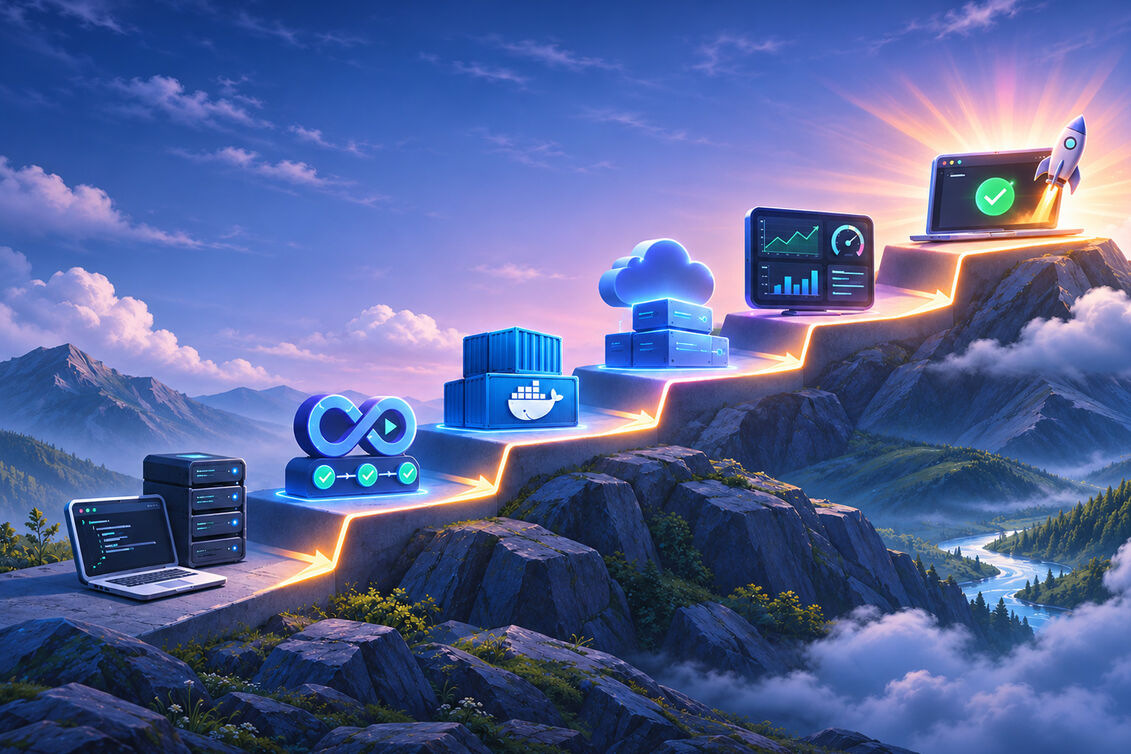
Wondering how to develop a DevOps process from scratch without freezing feature work? These steps to build a DevOps process from scratch in 2026 work as a DevOps implementation roadmap for startups and larger teams alike. CI/CD, infrastructure as code, monitoring, security, and team ownership reinforce one another; installing tools alone does not create a DevOps process.
Step 1: Define Core Delivery and Reliability Metrics
Start by measuring where you are. Track deployment frequency, lead time for changes, change failure rate, and time to restore service- the four DORA metrics. Capture a baseline over several weeks before setting targets. These numbers are not universal goals: a regulated fintech and an early-stage SaaS product will reasonably land in different places. Assign each metric an owner and define what counts as a failure, such as a release that degrades the user experience, because stability metrics only mean something when tied to real incidents.
Step 2: Standardize Source Control and Environment Parity
Put code, configuration, and pipeline definitions in version control and agree on one branching model. Enable protected branches so changes to the main branch require passing checks and peer code review. Move secrets out of repositories into a managed secrets store with access logging. Then address parity: development, staging, and production should differ in scale, not behavior. The Twelve-Factor App methodology treats dev/prod parity as a core principle, since inconsistent environments are a frequent reason a release passes staging and fails in production.
Step 3: Automate Build, Testing, and Staging Pipelines (CI/CD)
This is where teams build a CI/CD pipeline and DevOps workflow others can trust. On every pull request, run linting, unit tests, and dependency checks. Build a versioned artifact once and promote that same artifact from staging to production. Deploy to staging automatically and gate production with approvals proportionate to risk. Add rollback safeguards, such as retaining previous artifacts and using feature flags, and document exceptions like database migrations, where rollbacks are rarely trivial. Keep pipelines fast enough that developers will wait for them; slow feedback invites workarounds.
Step 4: Codify Cloud Infrastructure and Security Guardrails
Infrastructure as Code (IaC) tools such as Terraform or OpenTofu define networks, compute, and databases in reviewed, versioned files. The payoff is repeatable provisioning: a new environment becomes a pull request instead of a week of console clicks. Layer guardrails on top: least-privilege access roles, multi-factor authentication, policy checks on IaC changes, and automated vulnerability scanning of dependencies and container images. NIST's Secure Software Development Framework (SSDF) offers a vendor-neutral reference for these practices.
Step 5: Implement Actionable Monitoring and Feedback Loops
Monitoring closes the loop. Track uptime, latency, and error rates for each critical service, and add cloud spending so cost anomalies surface early. Alert on symptoms users actually feel rather than every metric that moves; Google's SRE guidance recommends this to limit noisy paging. Pair every alert with a short runbook covering what it means, how to check, who to contact, and how to roll back. Review incidents without blame and feed the lessons into steps one through four. Monitoring also confirms whether the baseline metrics from step one are improving.
4. Frequently Asked Questions
How long does it take to implement a DevOps process from scratch?
Many teams can establish core CI/CD and environment automation in roughly 4–8 weeks, but treat that as an illustrative estimate, not a guarantee. Timelines depend on team size, existing infrastructure, application complexity, security requirements, and how much manual process must be untangled first. A monolith without tests takes longer than a containerized service with solid coverage. Implementation can be phased, starting with one service while feature delivery continues. Monitoring, security hardening, and cultural change continue well beyond the initial build.
Do small engineering teams need a dedicated DevOps hire on day one?
Not always. Small teams can often establish foundational automation first and hire full-time later. A fractional DevOps architect can design the pipeline and standards, an external consultant can build and hand over the work, or a phased roadmap can automate the highest-risk steps first. Once pipelines, IaC, and monitoring exist, the team can define what a full-time role should own. Founders weighing whether to outsource DevOps implementation services should consider release complexity, compliance needs, and on-call load.
5. Work With NanoByte Technologies to Build a Reliable DevOps Process
NanoByte Technologies is a software engineering partner for startups and enterprises. For DevOps, we help teams assess existing delivery workflows, plan implementation, improve CI/CD pipelines, standardize environments, and strengthen cloud infrastructure and monitoring.
Whether you are looking for a DevOps consulting company for startups or enterprise DevOps transformation consulting for a larger organization, we start with your current state and goals rather than a fixed toolset. Once the roadmap is clear, teams that need extra capacity can hire DevOps engineers through NanoByte.
Not Sure Where Your Delivery Process Stands?Book a Free 15-Minute DevOps & CI/CD Readiness Audit. It is a short, consultative conversation to review your current delivery workflow and identify practical first steps. You can also review senior DevOps engineer profiles at NanoByte Technologies. |
.png)
 at the Edge Replacing Heavy Docker Containers for Ultra-Low Latency APIs.jpg)