How to Build a Custom In-House LLM Gateway to Route and Cut OpenAI/Anthropic API Costs
29 Oct 2026
Quick Summary: How Does an LLM Gateway Help Reduce AI API Costs?
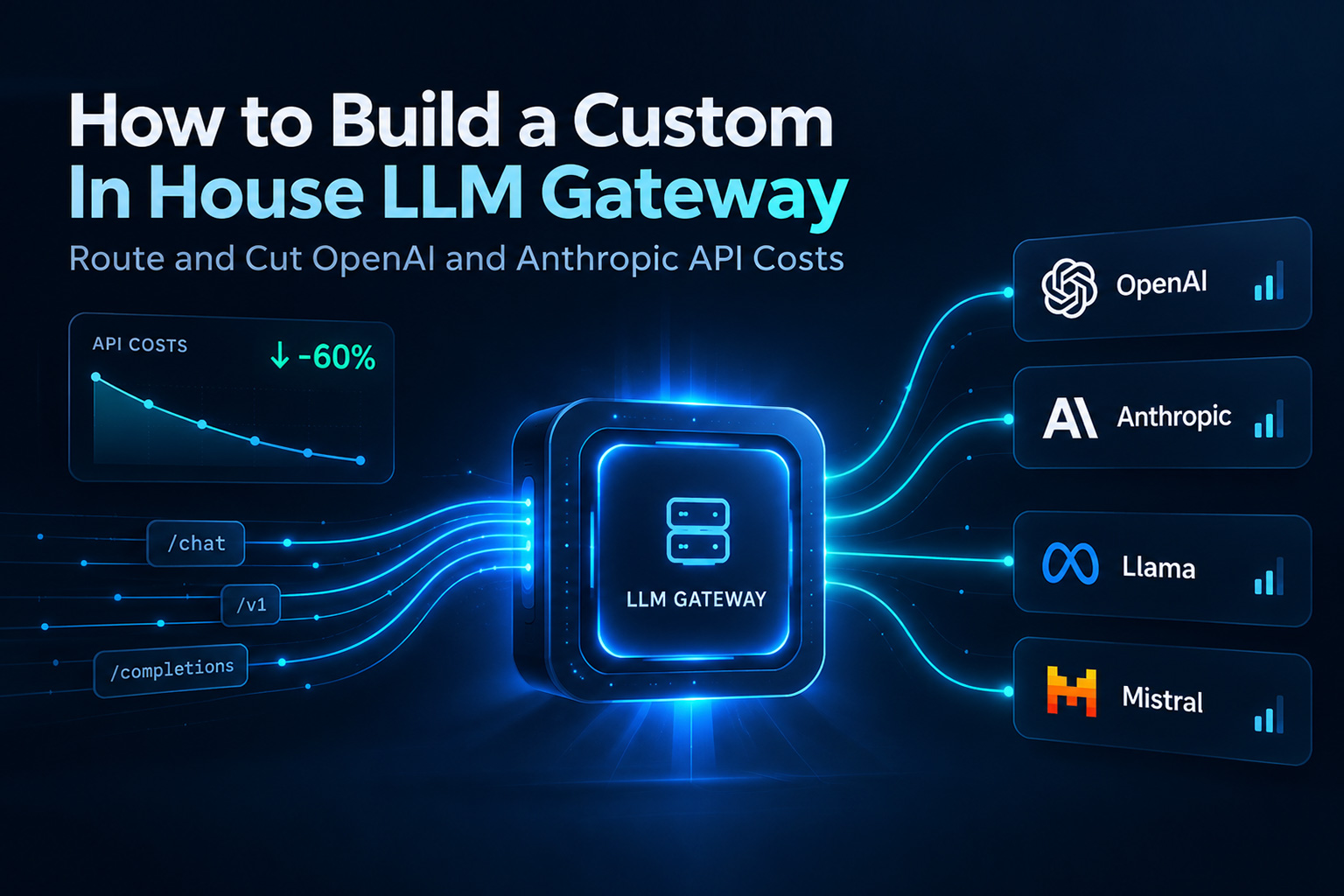
An LLM gateway centralizes model access, applies caching and routing policies, manages token budgets, and supports observability and controlled failover. Potential savings depend on measured workload patterns, implementation quality, provider pricing, infrastructure overhead, and evaluation of output quality and reliability.
1. Why Direct LLM API Integration Can Increase Costs
Direct API integration is often the simplest way to introduce AI into a product. However, as more teams adopt large language models, individual applications can develop separate model-selection logic, prompt templates, retry mechanisms, logging, and spending controls. This fragmentation makes it harder to manage costs consistently.
Several patterns deserve attention. Repeated requests and stable instructions may create opportunities for caching. Simple classification or data extraction might not require the same model as a complex reasoning task. Long conversation histories can introduce unnecessary input tokens, while unrestricted outputs increase generation costs. Poorly controlled retries can also repeat expensive requests.
Limited usage visibility presents another challenge. An organization may know its total API expenditure without understanding which teams, features, users, or workflows drive it. Inconsistent handling of provider rate limits and outages can further complicate operations.
An in-house gateway can centralize these controls, but it is not automatically a cost-saving solution. Its value depends on the workload, implementation quality, and measurable improvement over the existing architecture.
2. Direct API Calls vs. a Custom In-House LLM Gateway
An LLM gateway introduces a shared policy layer between applications and model providers. Rather than implementing the same controls independently in every service, engineering teams can manage them through a common interface.
|
Architectural area |
Direct integration |
Gateway-based approach |
|
Model selection |
Routing logic repeated across applications |
Centralized, testable routing policies |
|
Caching |
Implemented separately or omitted |
Shared exact-match and semantic caching |
|
Cost controls |
Scattered limits and reporting |
Centralized budgets, token tracking, and alerts |
|
Reliability |
Provider handling in individual services |
Shared retries, timeouts, and controlled fallback |
|
Observability |
Fragmented usage records |
Centralized request and cost attribution |
|
Security |
Different controls across applications |
Consistent authentication and access policies |
These are architectural possibilities, not guaranteed outcomes.
A gateway typically handles authentication, request validation, model routing, provider adapters, usage metering, and operational visibility. A complete AI orchestration platform may additionally manage retrieval-augmented generation (RAG), agent workflows, task planning, and model serving. Those capabilities can remain separate when the architecture does not require them inside the gateway.
3. A Four-Step Engineering Blueprint for an Enterprise LLM Gateway
Step 1: Implement Caching Safely
Caching can reduce repeated work when a request and its previous response are suitable for reuse. The first step is distinguishing exact-match caching from semantic caching.
Exact-match caching returns a stored response when a request matches a previously processed request under a defined cache key. That key should account for response-affecting inputs, including model version, messages, tool configuration, output format, locale, and relevant authorization scope.
Semantic caching identifies questions that are similar in meaning, even when their wording differs. It typically uses embeddings and vector similarity search to retrieve candidate responses. Technologies such as Redis and pgvector can support this architecture.
Docs
A safe implementation needs more than a similarity search. Teams must evaluate whether similar questions genuinely permit the same answer. For example, two questions about a company's refund policy might differ by subscription type, purchase date, or jurisdiction.
Important safeguards include:
- Evaluate similarity thresholds using representative queries rather than adopting a universal value.
- Apply tenant and authorization filters before accepting a cache hit.
- Set expiration rules and invalidate entries when underlying information changes.
- Avoid reusing sensitive or personalized responses across users.
- Monitor cache poisoning, incorrect matches, and stale answers.
A semantic cache hit is not literally free. Embedding generation, vector retrieval, storage, infrastructure, and maintenance all have costs. The objective is to reduce total cost without compromising response accuracy or security.
Step 2: Build a Complexity-Based Model Router
A model router decides which model should handle a request based on its requirements. It should consider task complexity, context length, latency targets, output format, tool requirements, provider health, and measured model quality.
For example, a smaller, less expensive model may be sufficient for structured extraction, straightforward classification, or basic text transformation. A more capable model may be necessary for complex reasoning, difficult coding tasks, or workflows involving multiple tools.
The router should use explicit policies rather than assuming that the cheapest available model is appropriate for every request.
A practical routing strategy includes:
- Classifying requests into defined task categories.
- Assigning eligible models to each category.
- Evaluating candidate models against representative production tasks.
- Escalating requests when validation or quality checks fail.
- Reviewing routing decisions as models, pricing, and requirements change.
Measure task success, factual accuracy, structured-output validity, tool-call correctness, latency, and cost per successful task. This provides a more useful basis for optimization than comparing token prices alone.
Provider compatibility also requires attention. OpenAI and Anthropic can differ in request formats, tool-calling behavior, structured outputs, context limits, and safety controls. A shared interface simplifies integration, but provider-specific behavior must still be tested.
Step 3: Enforce Token Budgets and Optimize Prompts
A cost-aware gateway should control both input and output tokens. Long prompts, unnecessary conversation history, duplicate context, and unrestricted response lengths can all increase expenditure.
Set limits appropriate to each feature and request category. For larger deployments, establish budgets at the team, user, and application levels. Track estimated spending before dispatch where possible, reconcile it against actual provider usage, and alert teams when usage exceeds expected patterns.
Prompt optimization can further reduce unnecessary tokens. Useful techniques include removing duplicate context, retaining only relevant conversation turns, retrieving targeted source passages, and separating stable instructions from changing user content.
Provider-side prompt caching is another option. OpenAI documents caching behavior for eligible prompt prefixes, while Anthropic offers prompt-caching features with provider-specific pricing and expiration behavior. Eligibility, costs, and configuration can change, so check the current official documentation before implementation.
However, shorter prompts are not necessarily better prompts. Compression must preserve essential instructions, context, safety requirements, and output quality. Test optimized prompts against a versioned evaluation set before deploying them broadly.
Step 4: Add Reliable Provider Fallback and Observability
A gateway can centralize failure handling, but switching providers does not guarantee uninterrupted service.
Start by distinguishing transient failures from permanent errors. Rate limits, timeouts, and temporary server errors may justify retries, while invalid requests generally require correction rather than repeated submission.
Use bounded exponential backoff with jitter, respect provider retry-after guidance, enforce request deadlines, and apply circuit breakers when a route becomes unhealthy. Design carefully around ambiguous timeouts to avoid duplicate work or side effects.
Fallback to another model or provider should be explicitly tested. The alternative may have different context limits, tool-calling semantics, structured-output behavior, safety policies, or response quality. A self-hosted model served through vLLM may be suitable for selected workloads, but it also introduces infrastructure, GPU capacity, scaling, and maintenance costs.
Observability should cover the full request lifecycle. Record:
- Provider, model, routing decision, and cache status.
- Input and output tokens, estimated cost, and actual cost.
- Latency, retries, errors, and fallback activity.
- Trace identifiers and relevant quality-evaluation signals.
Protect this data with access controls, secrets management, prompt redaction where appropriate, and defined retention policies.
Ultimately, evaluate the gateway by its cost per successful task, response quality, error rate, and latency percentiles. Lower token expenditure alone does not demonstrate a better system.
4. Frequently Asked Questions
How much can an enterprise save by building a custom LLM gateway?
There is no universal savings percentage that applies to every enterprise. Results depend on request patterns, caching eligibility, model selection, prompt sizes, provider pricing, retry behavior, and the infrastructure required to operate the gateway.
Establish a baseline using representative production workloads. Then compare total operating costs and output quality after introducing routing, caching, or prompt optimization. Include gateway infrastructure and maintenance in the calculation, and report savings only when the workload and quality requirements remain comparable.
Does adding an LLM gateway introduce noticeable latency?
A gateway introduces additional processing and network overhead. However, caching may reduce overall response time for eligible requests by avoiding a model-generation call.
The result depends on deployment location, request size, authentication checks, routing complexity, cache implementation, and provider response times. Measure end-to-end latency at p50, p95, and p99, alongside gateway overhead and cache-hit accuracy. Avoid assuming a universal latency penalty or guaranteed response time.
5. Reduce LLM Operating Costs with NanoByte Technologies
NanoByte Technologies supports businesses with AI engineering, backend development, LLM integration, workflow automation, and enterprise software development.
For organizations evaluating an in-house LLM gateway, the engineering scope may include reviewing current API usage, designing model-routing policies, implementing appropriate caching, introducing token budgets, and improving cost and reliability monitoring.
Businesses looking to hire custom AI backend developers or senior AI infrastructure engineers can work with an engineering partner to assess existing systems, integrate provider APIs, and test optimization opportunities against real workloads.
Whether you need an enterprise LLM routing middleware solution or custom AI cost optimization consulting, the right approach should reflect your workload, security requirements, existing infrastructure, and internal engineering capabilities.
Build a More Cost-Efficient LLM Architecture
Managing rising LLM API costs or struggling with model routing and provider reliability? Partner with NanoByte Technologies to assess your AI architecture and identify practical optimization opportunities.