
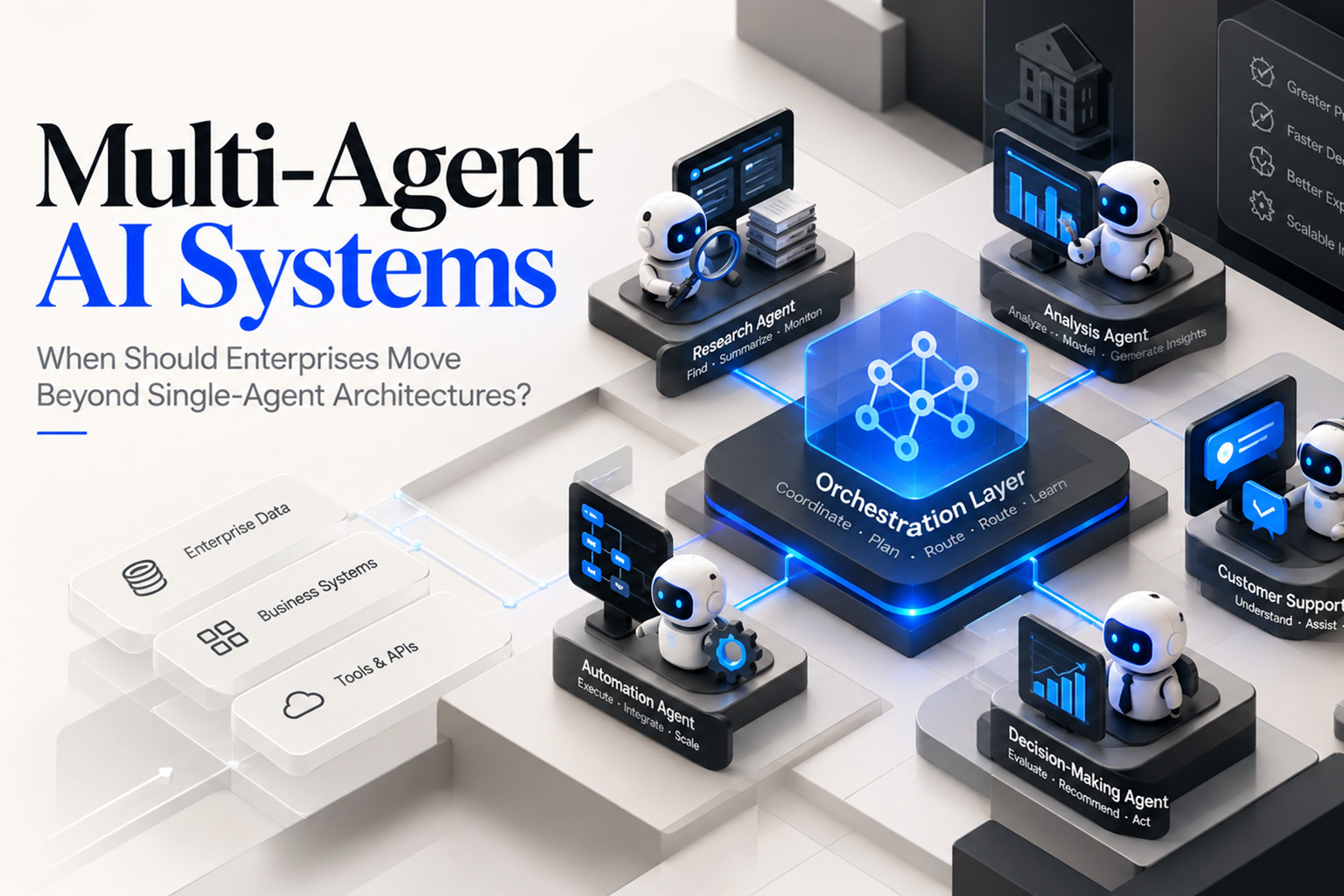
Multi-Agent AI Systems: When Should Enterprises Move Beyond Single-Agent Architectures?
24 Sep 2026
Most enterprise AI initiatives start the same way: one agent, a handful of tools, and a well-defined task. It answers questions, retrieves documents, drafts content, or triggers a workflow step. For a long stretch of that agent's life, this is enough.
Then the scope grows. More tools get attached. More edge cases appear. More stakeholders want the agent to handle stages of work that used to belong to different systems entirely. At some point, a team starts asking whether it's time to split that single agent into several specialized ones.
The question worth asking isn't “are multi-agent systems better?” It's narrower and more useful: does this specific workflow justify the orchestration complexity that comes with multiple agents? That question is the center of this article.
Quick Summary: What Is a Multi-Agent AI System?
A multi-agent AI system is an architecture in which multiple specialized AI agents, each scoped to a role, tool set, or stage of work, coordinate through a shared mechanism such as an orchestrator, shared state, or structured message passing. It is not the same as full autonomy; most production multi-agent systems still rely on defined control flow and, often, human checkpoints.
1. The Single-Agent Ceiling: When Does a Single Agent Become Difficult to Manage?
Single-agent architectures don't fail outright as complexity grows; they become harder to reason about and maintain. A few patterns show up repeatedly.
Context complexity. As instructions, tool descriptions, retrieved documents, and workflow state accumulate in one agent's context, keeping that context coherent gets harder. This is a maintainability problem, not proof that large prompts cause errors on their own.
Tool selection. A single agent can technically call a large number of tools. In practice, large tool inventories can make tool routing less predictable, since the model has more options to weigh on every step.
Workflow complexity. Sequential or branching logic, “do A, then depending on the result, do B or C, then loop until D is satisfied”, becomes harder to trace and debug when a single agent owns every stage.
Failure isolation. When one agent is responsible for an entire pipeline, isolating which stage failed, and retrying just that stage, is more difficult than it is when stages are separated by design.
None of this means a single agent has hit a hard limit. It means the engineering cost of keeping one agent coherent starts to rise, and at some point a different structure may be more maintainable.
2. Single-Agent Architecture vs. Multi-Agent Orchestration
|
Dimension |
Single-Agent Architecture |
Multi-Agent Architecture |
|
Task handling |
One agent handles multiple stages |
Specialized agents handle defined roles |
|
Context |
Centralized context |
Context can be separated by role or workflow stage |
|
Tool access |
One agent may access many tools |
Tools can be scoped to specific agents |
|
Parallel work |
Usually requires explicit workflow logic |
Independent agents can potentially work in parallel |
|
Error handling |
Centralized retry/recovery logic |
Failures can potentially be isolated by stage |
|
Observability |
One primary execution path |
More complex traces and interactions |
|
Cost |
Fewer model calls may reduce cost |
More model calls can increase cost |
|
Complexity |
Simpler to build and operate |
More orchestration and monitoring required |
|
Best fit |
Focused, bounded workflows |
Complex workflows with meaningful specialization |
Neither column is the default correct answer. The right fit depends on the workflow being automated, not on which architecture sounds more advanced.
3. The 4 Operational Triggers: When Should an Enterprise Consider Multi-Agent AI?
Trigger #1: Non-Linear, Multi-Domain Workflows
Some workflows span genuinely distinct areas of expertise. An AI-assisted software development pipeline, for example, might involve requirements analysis, code generation, testing, and review, each with different context, tools, and success criteria. This doesn't automatically require separate agents; a well-structured single agent or a workflow engine with explicit steps can sometimes handle the same work. Multiple agents become more useful when each stage needs different context boundaries or different tool permissions that shouldn't overlap.
Trigger #2: High-Volume Parallel Analysis
When independent units of work can be evaluated without depending on each other, parallel agents can process them concurrently before a synthesis step combines the results. A financial analysis workflow might assign separate agents to independently review different documents or risk categories, with a final agent consolidating the findings. Parallel execution isn't automatically faster in wall-clock terms, coordination overhead and model latency can offset the theoretical gain, particularly at smaller volumes.
Trigger #3: Human-in-the-Loop Approval
Some workflows need a defined point where a person, not a model, makes the final call. An AI-assisted customer support workflow might have one agent handle classification and draft a response, while higher-risk actions, a refund above a threshold, an account change- route to a human for approval before execution. This is an architectural decision driven by risk tolerance, not a limitation of single-agent design. Splitting the drafting and the approval-gated execution into distinct roles can make the checkpoint easier to audit.
Trigger #4: Independent Evaluation or Critique
In a generator-evaluator pattern, one component produces output and a separate component checks it against defined criteria before the workflow proceeds. This is not the same as automatic “self-correction”, it only becomes a correction loop if the system is explicitly built to route flagged output back for revision. Evaluation improves the odds of catching certain classes of error; it does not guarantee correctness, and the evaluator itself can be wrong.
4. When Should Enterprises NOT Use Multi-Agent AI?
This is where credibility in an enterprise AI architecture decision actually gets built. Multi-agent design is often unnecessary when:
- The task is simple and well-bounded
- One model can complete the workflow reliably on its own
- There's little genuine need for role specialization
- Tool access requirements are limited
- Workflow branching is minimal
- The added orchestration wouldn't provide meaningful value
- Cost and latency are hard constraints for the use case
The working principle: start with the simplest architecture that meets the requirement, and add agents when the workflow demonstrates a real, observed need , not because multi-agent design is the more discussed pattern in 2026.
5. How Do Multi-Agent Systems Control Cost, Latency, and Complexity?
Teams that run multi-agent systems in production tend to rely on a similar set of controls rather than an architecture that manages itself:
- Routing, sending simpler sub-tasks to smaller or cheaper models
- Model selection per agent, matched to task difficulty rather than using one model tier everywhere
- Tool scoping, limiting each agent to the tools its role actually needs
- Context management, keeping each agent's input focused rather than accumulating full history by default
- Caching, where responses or intermediate results can be reused
- Parallel execution, where independent steps genuinely don't depend on each other
- Maximum iteration limits, so evaluator-generator loops or retries can't run indefinitely
- Human approval gates at defined risk points
- Observability and tracing across agent-to-agent handoffs, not just the final output
- Evaluation steps built into the workflow itself
- Budget and token controls with defined ceilings per run
Using a smaller model for a sub-task doesn't automatically preserve output quality, that trade-off has to be validated per task, not assumed.
6. What Frameworks Can Enterprises Consider?
Framework choice depends on the specific workflow, state management needs, deployment environment, and existing engineering stack, there isn't a universally correct pick.
LangGraph, from the LangChain team, structures agent workflows as directed graphs, where nodes represent agents or tools and edges define execution flow, including conditional branching and human-in-the-loop checkpoints. It's commonly used where teams want explicit, auditable control over state and branching logic.
Microsoft Agent Framework is Microsoft's current agent-orchestration framework, positioned as the successor to AutoGen, which Microsoft moved into maintenance mode in early 2026. It combines multi-agent orchestration patterns with Semantic Kernel's enterprise session management, telemetry, and Model Context Protocol (MCP) support, and is a natural fit for teams already standardized on Azure.
CrewAI organizes agents into role-based “Crews” for collaborative work, with “Flows” available for more deterministic, event-driven sequencing. It's frequently chosen for role-based orchestration where teams want a faster path from prototype to a working multi-agent pipeline.
Enterprise teams also build custom orchestration layers on top of, or instead of, these frameworks when requirements call for it, framework selection is a means to an architecture, not the architecture itself.
7. Frequently Asked Questions
What are the main frameworks for building multi-agent AI systems?
LangGraph, Microsoft Agent Framework, and CrewAI are commonly used in 2026, alongside custom orchestration layers. The right choice depends on the workflow's state management needs, deployment environment, observability requirements, and the team's existing engineering stack.
How do multi-agent systems control API costs and token consumption?
Through model routing to smaller models for simpler sub-tasks, tighter context scoping per agent, tool restrictions, caching of repeated calls, iteration limits on loops, and observability that surfaces where token spend is concentrated.
Is multi-agent AI better than single-agent AI?
Not necessarily. The appropriate architecture depends on workflow complexity, the degree of genuine specialization needed, tool usage patterns, reliability requirements, latency tolerance, cost constraints, and operational maturity.
When should an enterprise use multi-agent systems?
When a workflow shows one or more of the four operational triggers: genuinely distinct domains of work, high-volume parallel analysis, defined human-approval checkpoints, or a need for independent evaluation of generated output.
Are multi-agent AI systems more expensive?
They can be, since more model calls and orchestration overhead typically mean higher token consumption and infrastructure cost. Actual cost depends heavily on the specific architecture, model choices, and workload volume, it isn't a fixed penalty.
8. Building Enterprise Multi-Agent AI Systems With NanoByte Technologies
The starting question for an enterprise AI initiative shouldn't be “how many agents should we build?” It should be about the workflow itself: what does it require, what are the risk constraints, which tools does it need access to, and what outcome actually matters to the business.
NanoByte Technologies works with enterprise teams to evaluate whether a single-agent, multi-agent, or hybrid architecture fits a given workflow before development begins. That evaluation draws on AI strategy, custom AI product development, LLM and RAG solutions, AI agents, and enterprise software engineering, brought together around the specific problem, not a predetermined architecture.
For organizations exploring custom multi-agent AI development, evaluating whether to hire multi agent AI developers, or scoping agentic AI development services as part of a broader enterprise generative AI architecture, the practical starting point is the workflow assessment, not the framework selection.
|
Ready to Evaluate a Multi-Agent AI Architecture? Complex AI workflows do not always need more agents. They need the right architecture. Talk to NanoByte Technologies about your workflow, AI architecture, and development requirements. |
.jpeg)