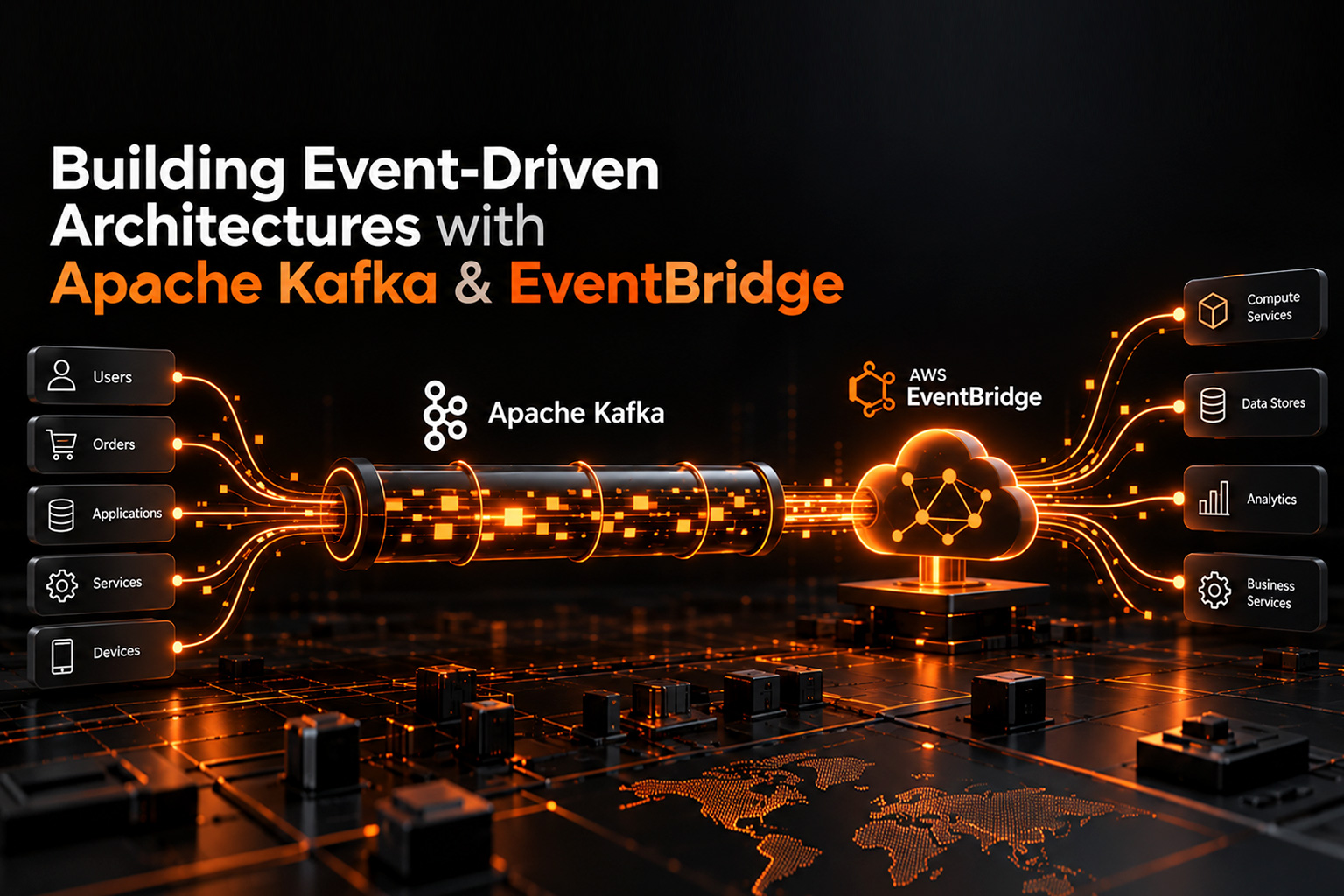
Building Event-Driven Architectures with Apache Kafka & EventBridge: A CTO's Blueprint
29 Sep 2026
Quick Summary: What Is a Hybrid Kafka + EventBridge Architecture?
A hybrid Kafka and EventBridge architecture uses Apache Kafka for durable, high-throughput event streaming and Amazon EventBridge for managed event routing and integration with AWS services or external SaaS systems. It fits when event types differ in retention, processing, and integration needs. It is an architectural option, not a default.
1. The Synchronous Architecture Trap
Consider Service A → REST call → Service B → database → Service C → external API. Each hop adds latency and a dependency. When the external API slows down, Service C holds resources, Service B's calls time out, and Service A's callers wait on the whole chain. Timeouts propagate upstream, clients retry, and the added load lands on an already struggling system: a retry storm. Deployments couple too, since a contract change in Service C can force coordinated releases.
Synchronous APIs are not inherently bad. When a caller needs an answer now, a direct call is the right tool. Event-driven architecture earns its place when asynchronous processing, buffering, or independent service execution is the better fit.
Why Polling Can Become an Architectural Problem
Polling asks on a timer whether something changed. Every poll is a query even when nothing changed; changes are detected only at the next interval; several pollers can grab the same record and duplicate work or race, and load grows with pollers rather than changes.
Events reverse the direction: a producer announces that something happened.
Order created → OrderCreated event → inventory service + payment service + notification service.
The order service does not know who consumes the event, so adding a fourth consumer requires no change to it.
2. Apache Kafka vs. AWS EventBridge: When to Use Which?
Kafka and EventBridge overlap but are not interchangeable. Apache Kafka is a distributed event-streaming platform, and Amazon MSK is AWS's managed service for running it. MSK reduces cluster operations, but topic design, partitioning, and consumer behavior remain yours. EventBridge is a managed event bus that routes events to targets using rules.
|
Architectural Dimension |
Apache Kafka |
AWS EventBridge |
|
Core role |
Distributed event streaming/log platform |
Managed event bus and event routing |
|
Typical fit |
High-volume streams, durable event history, stream processing |
Event routing, AWS service integration, SaaS/application events |
|
Event retention/replay |
Durable log retention and consumer-controlled offsets |
Retention/replay capabilities depend on the EventBridge feature and configuration |
|
Scaling model |
Partition-based distributed streaming |
Managed AWS event routing |
|
Consumer model |
Consumer groups and offsets |
Event targets, rules, and event buses |
|
Operations |
Requires operational and configuration management, depending on deployment |
AWS manages the underlying service infrastructure |
|
Best fit |
Streaming-centric architectures |
Event-routing-centric architectures |
Kafka vs EventBridge: The Architectural Decision
Choose a Kafka-oriented architecture when you need:
• Durable event streams
• Consumer groups and replayable event history
• Stream processing and high-volume continuous data
• Fine-grained control over partitions and consumers
• Kafka ecosystem compatibility
Consider EventBridge when you need:
• Managed event routing with event buses and rules
• AWS service integration
• SaaS and application integrations
• Less infrastructure to manage
Consider a hybrid architecture when:
• Internal systems require Kafka-style streaming
• External or cloud events benefit from managed routing
• Event types have different delivery and processing requirements
• You already operate Kafka and need event-driven AWS integrations
Hybrid is not automatically superior: two platforms mean two operational models, two sets of limits, and two places to debug. Many enterprises need only one. Decide from workload characteristics such as event size, partitioning, consumers, region, and service limits, not a headline throughput number.
3. How a Hybrid Kafka + EventBridge Architecture Can Work
A simple hybrid design has two paths:
Core applications → Kafka → stream processors/consumers → business services
AWS/SaaS events → EventBridge → application targets
How the paths connect depends on the architecture. Kafka → integration layer → EventBridge suits curated business events that must trigger AWS-native workflows or reach SaaS targets. EventBridge → integration layer → Kafka suits AWS or SaaS events that must join a durable stream for processing or replay. AWS documents Kafka clusters, including Amazon MSK, as a source for EventBridge Pipes, which batches messages and can filter and enrich them before delivery to a target.
An integration layer, whether Pipes, Kafka Connect, or a custom service, is often justified for transformation, filtering, validation, authentication, schema mapping, and delivery handling. Kafka and EventBridge need not always be connected directly; do so only where a requirement exists.
4. The Four Technical Pillars of Resilient Event-Driven Systems
Pillar 1: Schema Governance and Schema Evolution
An event is a contract; without governance, a producer that renames a field can silently break consumers. Common formats include JSON, Avro, Protobuf, and JSON Schema for validating JSON. None is universally best, so choose by tooling, skills, and consumer needs. Registries such as Confluent Schema Registry and AWS Glue Schema Registry store versions and enforce compatibility rules. Backward compatibility means consumers on the new schema can read old data; forward compatibility means consumers on the old schema can read new data. Version events deliberately and validate at publish and consume time.
Pillar 2: Idempotent Consumers and Delivery Semantics
At-most-once delivery can lose messages. At-least-once delivery avoids loss but permits duplicates. Exactly-once semantics, which Kafka supports through idempotent producers and transactions, apply only inside a defined boundary. Duplicates still arise from producer retries after lost acknowledgments, consumer crashes before offsets are committed, rebalances, and target retries. AWS documents durable delivery of AWS service events as at least once.
If PaymentCompleted is delivered twice, exactly-once semantics do not extend to external side effects such as a card-processor call, so the consumer must prevent the double charge itself: record the event ID or idempotency key in the same transaction as the effect, skip events already seen, and pass idempotency keys to downstream APIs that support them.
Pillar 3: Dead-Letter Queues and Failed Event Handling
Malformed messages and schema mismatches will not succeed on retry, temporary downstream failures often will, and a poison message can stall a partition if a consumer retries it forever. Use bounded retries with exponential backoff, then route the event to a dead-letter destination. EventBridge supports a per-target retry policy, with maximum event age from 1 minute to 24 hours and 0 to 185 retry attempts, plus an Amazon SQS dead-letter queue for undelivered events. In Kafka, dead-letter topics are an application pattern. Alert on dead-letter depth, investigate, fix the cause, and replay.
A DLQ is a recovery mechanism, not a complete reliability strategy. Without ownership, alerting, replay tooling, and idempotent consumers, it becomes a graveyard.
Pillar 4: Outbox Pattern and Reliable Event Publishing
A service updates its database and crashes before publishing OrderCreated, or publishes and then rolls back. The Outbox Pattern removes that dual write:
Application transaction → database update + outbox record → commit → publisher/CDC → event broker
Both writes share one local transaction. A separate publisher, often change data capture with Debezium, reads the outbox and publishes to the broker; Debezium provides an outbox event router transformation for Kafka Connect. Publication is at least once, so consumers must stay idempotent. The pattern addresses reliable publication of events tied to a local database transaction. It does not make a multi-service workflow atomic, which needs patterns such as sagas.
5. Building Resilient Event-Driven Microservices
Resilience comes from habits applied consistently:
• Design for duplicate delivery and make handlers idempotent.
• Set timeouts on every outbound call.
• Retry carefully: cap attempts, use exponential backoff with jitter, and retry only safe operations. Immediate, unlimited retries can turn a partial outage into a full one by hammering a struggling dependency.
• Use circuit breakers around dependencies that may stay unhealthy.
• Isolate failures with separate consumer groups, queues, and dead-letter handling per workload.
• Monitor consumer lag and validate event schemas at boundaries.
• Maintain correlation IDs across every hop.
• Assign a named owner to each event contract.
6. Observability for Kafka and EventBridge Architectures
For Kafka, watch consumer lag, broker health, partition distribution, throughput, processing errors, and replication health. For EventBridge, watch delivery failures, rule and target behavior, invocation failures, throttling, and dead-letter deliveries, and event processing outcomes through event bus logging. At the application level, use correlation IDs, distributed tracing across asynchronous hops, structured logs, and business-event monitoring, such as orders without a matching payment. Base alert thresholds on your own baselines and objectives.
7. Common Event-Driven Architecture Mistakes
• Introducing Kafka when a simpler queue or event bus is sufficient
• Treating EventBridge as a replacement for every streaming workload
• Skipping schema governance
• Assuming events are delivered only once
• Having no idempotency strategy
• Allowing unlimited retries
• Having no dead-letter handling
• Coupling consumers too tightly to producer schemas
• Running without observability
• Using events where a synchronous response is required
• Leaving event ownership undocumented
• Ignoring operational costs and service limits
Frequently Asked Questions
How do you choose between Apache Kafka and AWS EventBridge?
Kafka fits streaming-centric designs that need durable retention, consumer-controlled offsets, replay, and partition-level control, at the cost of more operational work. EventBridge fits routing-centric designs that need rules, AWS integration, SaaS events, and managed infrastructure. No single throughput number decides it.
What is the Outbox Pattern in event-driven microservices?
The Outbox Pattern writes a business change and an event record to an outbox table in one local database transaction. After commit, an asynchronous publisher or CDC tool reads the outbox and sends the event to the broker. Committed changes no longer lose their events, though delivery is at least once.
Is Kafka the same as EventBridge?
No. Kafka is a distributed event log built for streaming, retention, and consumer groups. EventBridge is a managed event bus that routes events to targets by rule. They overlap because both move events, but they solve different architectural problems.
Can Kafka and EventBridge be used together?
Yes, where the architecture needs it. Common patterns are Kafka → integration layer → EventBridge and EventBridge → integration layer → Kafka. The layer, such as EventBridge Pipes, Kafka Connect, or a custom service, handles transformation, filtering, validation, authentication, and schema mapping.
How do event-driven systems handle duplicate messages?
They assume duplicates will happen. Give every event a unique ID, make consumers idempotent, and record processed IDs transactionally with side effects. Pass idempotency keys to external APIs, since exactly-once processing inside a broker does not stop an external action from running twice.
How do you prevent cascading failures in event-driven microservices?
Decouple services with queues or streams, set timeouts, cap retries with exponential backoff, and add circuit breakers around unhealthy dependencies. Isolate workloads, route failures to dead-letter handling, and monitor lag and error rates.
Modernize Your Architecture with Event-Driven Engineering
Choosing Kafka, EventBridge, or both is an architecture decision with cost and operational consequences. NanoByte Technologies combines human expertise with AI-powered development to help organizations design and build event-driven platforms across enterprise software, backend engineering, and cloud architecture.
Whether you need enterprise event-driven architecture services, a custom Apache Kafka development company, or Kafka streaming pipeline developers, the work usually starts with event modeling, schema design, and microservices modernization. Some teams need AWS EventBridge architecture integration or Kafka to EventBridge integration services; others need resilient messaging from custom message queue software developers. If you want to hire event-driven software architects or senior backend streaming engineers, NanoByte's IT staff augmentation can extend your team.
Planning to modernize a tightly coupled backend or build a new event-driven platform? Partner with NanoByte Technologies to design and develop an event architecture aligned with your workload, reliability, integration, and operational requirements.
.jfif)